

">

Showing 73–84 of 358 results
-


Motorola V3
Quick View💎 Rarity Index: D (Very Common)
👁 Evaluation in my collection: Great – 9.0/10
🕵 Motorola Codename: Siliqua
⏱ Life timer: N/A | 📦 Boxed: YES
📅 Release Year: 2005 | 💰 Release Price: ~450 $
📊 Units Sold: ~130M
📰 Why this phone matters: The Motorola Razr (styled RAZR codenamed Siliqua) was a series of mobile phones by Motorola, part of the 4LTR line. The V3 was the first phone released in the series and was introduced in July 2004 and released in the market in the third quarter of 2004.The V3 model was followed soon thereafter by the improved V3i, including a collaboration with Apple Inc. for iTunes to be built-in. It was launched in 2005.Because of its unique appearance and thin profile, it was initially marketed as an exclusive fashion phone. However, within a year, its price was lowered and as a result, it sold over 50 million units by July 2006. Leading up to the release, Motorola’s cell phone division sales were stagnant and losing money. The success of the Razr made the division profitable again. Over the Razr’s four-year run, the V3 model sold more than 130 million units, becoming the best-selling clamshell phone in the world to date.
The Razr series was marketed until July 2007, when the succeeding Motorola Razr2 series was released. The succeeding models were the V8, the V9, and the V9m. However, Razr2 sales were not as good as the original V3 series, with consumers moving to competing products. Because Motorola relied so long upon the Razr and its derivatives and was slow to develop new products in the growing market for feature-rich touchscreen and 3G phones, the Razr appeal declined, leading Motorola to eventually drop behind Samsung and LG in market share for mobile phones. Motorola’s strategy of grabbing market share by selling tens of millions of low-cost Razrs cut into margins and resulted in heavy losses in the cellular division.
In October 2011, Motorola resurrected the Razr brand for a line of Android smartphones: the Droid Razr for Verizon Wireless (known simply as the “Motorola RAZR” on other networks) and an improved variant, the Droid Razr Maxx. The new “Razr” line shares the trademark thinness and stylized tapered corners with the original. The series was marketed until 2013.
On November 14, 2019, Motorola again revived the Razr brand, this time for an Android-based foldable smartphone styled after the original Razr, which carried the same name.
📝 Reviews when released: Mobile Review 🔗
-


Motorola V50
Quick View💎 Rarity Index: B (Uncommon)
👁 Evaluation in my collection: Great – 9/10
⏱ Life timer: N/A | 📦 Boxed: NO
📅 Release Year: 2000 | 💰 Release Price: N/A
📊 Units Sold: ~1.5M
📰 Why this phone matters: The Motorola V50 stands as one of the most elegant and compact folding phones of the late 1990s and marks a turning point in Motorola’s design language as the company transitioned from the iconic StarTAC era toward more refined clamshell engineering. Released in 1999, the V50 belonged to Motorola’s premium business class, offering a sophisticated build, extremely compact chassis, and the unmistakable industrial design that defined Motorola’s dominance during the GSM boom.This unit is in as-new condition and remains fully functional, a rarity today given the age of the model and the fragility of early clamshell hinges. The phone comes together with an original-style leather case, a period-correct accessory that was considered essential for protecting premium Motorola devices. The preserved state of this V50 makes it a desirable collector piece, as most surviving units show heavy wear, hinge slack, or display fading.
The V50 was notable for its engineering precision and extremely small footprint. At the time of release, it was one of the most compact dual-band GSM clamshells available, weighing around 83 g and offering a slim linear profile when closed. Motorola built the V50 on an evolution of the StarTAC mechanical platform, with improved hinge reinforcement, a tighter clamshell action, and upgraded internal components for better long-term durability compared to earlier models.
In the late 1990s, the V50 was positioned as a premium compact business device, bridging the gap between the iconic StarTAC and the more modern V-series models that would dominate the early 2000s. It carried the minimalist, understated design that Motorola became famous for, with tight tolerances, robust construction, and a sleek, business-oriented aesthetic. Because it was not a mass-market fashion device like later models, production volumes were lower, and surviving near-mint examples are uncommon.
Today, the V50 holds strong historical importance as part of Motorola’s transition from analog-to-digital GSM, as well as the evolution of the clamshell form factor. As a fully functional, as-new example paired with a period-correct leather case, this unit stands as a highly collectible piece of late-1990s mobile engineering. Its preserved condition, compact build, and clean mechanical structure make it a standout addition to any high-end GSM or Motorola-focused collection.
📝 Reviews when released: N/A 💔
-


Motorola V70
Quick View💎 Rarity Index: A (Rare)
⭐ WOW Factor: The first Motorola with a rotary design
👁 Evaluation in my collection: Good – 8.5/10
⏱ Life timer: N/A | 📦 Boxed: NO
📅 Release Year: 2002 | 💰 Release Price: ~400 $
📊 Units Sold: ~700k
📰 Why this phone matters: The Motorola V70 is by far one of the sleekest mobiles seen to date. Its innovative design; silver casing; compact size (3.7 by 1.5 by 0.7 inches; 2.9 ounces); and inverse-image (black background, white letters), five-line circular display all contribute to this mobile’s “wow” factor. But the real eye-catcher is its 360-degree rotating keypad cover.📝 Reviews when released: Cnet.com 🔗
-


Motorola VE66
Quick View💎 Rarity Index: B (Uncommon)
👁 Evaluation in my collection: BNIB – 10/10
⏱ Life timer: 0m | 📦 Boxed: YES
📅 Release Year: 2008 | 💰 Release Price: ~250 €
📊 Units Sold: ~1M
📰 Why this phone matters: VE 66 had the MotoMagx which is a Linux kernel-based mobile operating system developed and launched in 2007 by Motorola to run on their mid-to-high-end mobile phones. The system is based on MontaVista’s Mobilinux. Originally intended for the 60% of their upcoming devices, it was soon dropped in favor of Android and Windows Mobile operating systems.📝 Reviews when released: N/A 💔
-


NEC e616v
Quick View💎 Rarity Index: C (Common)
👁 Evaluation in my collection: Great – 9/10
⏱ Life timer: N/A | 📦 Boxed: NO
📅 Release Year: 2003 | 💰 Release Price: N/A
📊 Units Sold: ~2M
📰 Why this phone matters: N/A📝 Reviews when released: N/A 💔
-
NEC N900: Ultra-Compact 2004 GSM Phone
Quick View💎 Rarity Index: A (Rare)
⭐ WOW Factor: A phone so ahead of its time it forgot to include an earpiece – the NEC N900 is pure early-2000s sci-fi hardware.
👁 Evaluation in my collection: Great – 10/10
⏱ Life timer: N/A | 📦 Boxed: NO
📅 Release Year: 2004 | 💰 Release Price: ~320 $
📊 Units Sold: ~400k
📰 Why this phone matters: The NEC N900 is one of the most obscure and fascinating micro-handsets ever released in the early 2000s-a device that looks like a tiny PDA more than a phone, designed for the Chinese GSM/GPRS market and produced in extremely limited numbers. This particular unit stands out even further for its unconventional keypad layout, with keys positioned in a way that differs from final versions, suggesting an early-batch or special-production configuration rarely seen today.The N900 was engineered around minimalism and compactness, which led NEC to take one of its boldest decisions: the phone has no built-in earpiece. All voice calls must be made using the proprietary NEC headset, making it one of the few mobile phones in history that cannot be held to the ear to talk. This unusual constraint reflects NEC’s original intention for the N900 to be a messaging-centric smart device, not a traditional voice phone.
Despite its tiny footprint, the N900 packs surprising features for its era:
– a touch-style 2.2-inch display framed in metal
– circular metallic keys arranged in a distinctive grid
– full GSM/GPRS support
– NEC’s proprietary OS used on early N-series smart devices
– ultra-compact form factor comparable to the Nokia 82xx series, yet far more futuristic
This unit retains its authentic operator security seal, original structural components, and the rare keypad configuration-making it a genuinely collectible piece of early-2000s mobile experimentation.
A device like this embodies a short-lived moment when manufacturers dared to rethink what a phone could look like-before smartphones standardized everything. The NEC N900 is a perfect example of that creative chaos, and your piece is one of the cleanest surviving specimens.
📝 Reviews when released: N/A 💔
-


Nokia 1011: The mass GSM Genesis
Quick View💎 Rarity Index: B (Uncommon)
⭐ WOW Factor: The first mass produced GSM phone
👁 Evaluation in my collection: Great – 9/10
⏱ Life timer: N/A | 📦 Boxed: YES
📅 Release Year: 1992 | 💰 Release Price: ~2500 DM
📊 Units Sold: ~100k
📰 Why this phone matters: The Nokia 1011 is one of the most historically significant mobile phones ever produced, recognized as the first mass produced GSM handset in the world. Released on 10 November 1992, the model number itself reflects the launch date. This device marks the beginning of the digital mobile age and the starting point of Nokia’s rise as the dominant global mobile manufacturer. It was also sold as the Mobira Cityman 2000 during the transitional phase between Mobira and Nokia Mobile Phones branding.This unit is BNIB and comes in an extremely rare green housing, a color variant produced in very small numbers compared to the standard black version. Finding any Nokia 1011 in unused condition is exceptionally difficult. Finding one in green, boxed, complete, and fully functional places this device among the rarest known surviving examples of the 1011 family.
The Nokia 1011 features the earliest generation of GSM 900 MHz hardware, a monochrome LCD, an extendable antenna, and memory for 99 contacts. It predates the introduction of the Nokia ringtone by two years and represents the fundamental transition from analog communication to digital network reliability. In 1992 it retailed for about 2500 DM, the equivalent of roughly 1797 eur; today, reflecting its status as a premium business handset for early adopters.
Physically, the device follows the industrial design of the early 1990s with a tall form factor, robust plastics, and Nokia’s first steps into what would become its signature user interface. The green finish adds a unique visual identity rarely seen on this model and makes this specific unit highly desirable for collectors.
Because the 1011 was heavily used by professionals and early GSM adopters, most surviving units are worn, incomplete, or non functional. A BNIB example with manual, box, and rare color housing is almost impossible to find. This rare green Nokia 1011 stands as a genuine museum grade piece, directly connected to the origins of digital mobile communication and the earliest days of the GSM era.
📝 Reviews when released: N/A 💔
-
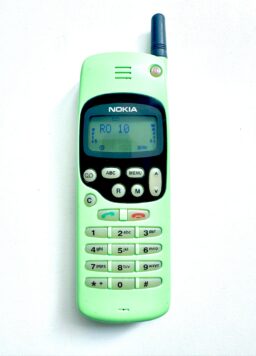

Nokia 1610
Quick View💎 Rarity Index: C (Common)
👁 Evaluation in my collection: Great – 9/10
⏱ Life timer: N/A | 📦 Boxed: YES
📅 Release Year: 1996 | 💰 Release Price: N/A
📊 Units Sold: ~10M
📰 Why this phone matters: Nokia 1610 is a mobile phone model manufactured by Nokia. It complemented the Nokia 2110 business model, but had significantly fewer features. It was introduced in April 1996 and released in May and became highly popular at the time.
The phone had a monochromatic display which could show two rows of text at a time. The operating manual did not mention a possibility to send text messages, but at least units sold from 1996 and onwards included the function. The SMS capable version was called 1610 Plus. The phone used an external rigid antenna, but had a groove on the inside of the battery to accommodate a pull-out type antenna. The 1610 used a credit card size SIM-card, and was powered by a NiMH type battery with a capacity of 600 mAh.📝 Reviews when released: N/A 💔
-


Nokia 2010
Quick View💎 Rarity Index: B (Uncommon)
👁 Evaluation in my collection: Great – 9.5/10
⏱ Life timer: N/A | 📦 Boxed: YES
📅 Release Year: 1994 | 💰 Release Price: N/A
📊 Units Sold: ~200k
📰 Why this phone matters: The Nokia 2010 is a mobile phone that was announced by Finnish phone manufacturer Nokia in January 1994.
According to the late Matti Makkonen, a manager of Nokia Mobile Phones at the time, Nokia 2010 was the first mobile phone to enable writing messages easily.
Other features include lists of 10 dialled calls, 10 received calls and 10 missed calls.
The phone has a monochromatic display that can show two rows of text at a time, which are surrounded by symbols for dedicated functions – battery status and reception level on either side; SMS message notification, keypad lock, et al. at the top. The handset has an antenna slot that supports either an external rigid antenna, or a pull-out type antenna (more common). The 2010 used a full-size (1FF) sim-card.
Nokia 2010 was the more affordable version in the 2xxx series than the business-oriented Nokia 2110, both of which were released in 1994.
In terms of design, the 2010 stayed truer to its predecessor model of Nokia 1011 than the 2110.📝 Reviews when released: N/A 💔
-


Nokia 2110 D2 Platinum
Quick View💎 Rarity Index: S (Ultra Rare)
⭐ WOW Factor: The first Nokia phone with famous Nokia ringtone
👁 Evaluation in my collection: Good – 8.5/10
⏱ Life timer: N/A | 📦 Boxed: NO
📅 Release Year: 1994 | 💰 Release Price: ~700 £
📊 Units Sold: ~1000
📰 Why this phone matters: Rare and special edition D2 Platinum Club 1/100 Series.The Nokia 2110 is a cellular phone made by the Finnish telecommunications firm Nokia, first announced in February 1994. It was the first Nokia phone with the famous Nokia tune ringtone.The phone can send and receive SMS messages, and lists 10 dialed calls, 10 received calls and 10 missed calls. At the time of the phone’s release, it was considerably smaller than others of its price and had a bigger display, so it became very popular. It also featured a “revolutionary” new user interface featuring with two dynamic softkeys, which would later lead to the development of the Navi-key on its successor, the Nokia 3110, as well as the Series 20 interface.
A later version, the Nokia 2110i, released in 1994, came with more memory and a protruding antenna knob.📝 Reviews when released: N/A 💔
-


Nokia 2110 Purple
Quick View💎 Rarity Index: C (Common)
⭐ WOW Factor: The first Nokia phone with famous Nokia ringtone
👁 Evaluation in my collection: Great – 9/10
⏱ Life timer: N/A | 📦 Boxed: NO
📅 Release Year: 1994 | 💰 Release Price: ~700 £
📊 Units Sold: ~1.5M,
📰 Why this phone matters: The Nokia 2110 is a cellular phone made by the Finnish telecommunications firm Nokia, first announced in February 1994. It was the first Nokia phone with the famous Nokia tune ringtone.The phone can send and receive SMS messages, and lists 10 dialed calls, 10 received calls and 10 missed calls. At the time of the phone’s release, it was considerably smaller than others of its price and had a bigger display, so it became very popular. It also featured a “revolutionary” new user interface featuring with two dynamic softkeys, which would later lead to the development of the Navi-key on its successor, the Nokia 3110, as well as the Series 20 interface.
A later version, the Nokia 2110i, released in 1994, came with more memory and a protruding antenna knob.📝 Reviews when released: N/A 💔
-


Nokia 2110 Wood
Quick View💎 Rarity Index: C (Common)
⭐ WOW Factor: The first Nokia phone with famous Nokia ringtone
👁 Evaluation in my collection: Great – 9/10
⏱ Life timer: N/A | 📦 Boxed: NO
📅 Release Year: 1994 | 💰 Release Price: ~700 £
📊 Units Sold: ~1.5M
📰 Why this phone matters: The Nokia 2110 is a cellular phone made by the Finnish telecommunications firm Nokia, first announced in February 1994. It was the first Nokia phone with the famous Nokia tune ringtone.The phone can send and receive SMS messages, and lists 10 dialed calls, 10 received calls and 10 missed calls. At the time of the phone’s release, it was considerably smaller than others of its price and had a bigger display, so it became very popular. It also featured a “revolutionary” new user interface featuring with two dynamic softkeys, which would later lead to the development of the Navi-key on its successor, the Nokia 3110, as well as the Series 20 interface.
A later version, the Nokia 2110i, released in 1994, came with more memory and a protruding antenna knob.📝 Reviews when released: N/A 💔