Showing 169–180 of 337 results
-


Nokia 6610i
Quick ViewThe Nokia 6610i mobile telephone is an improved version of the Nokia 6610 with a built-in digital camera, launched in 2004. The phone’s internals are taken from the Nokia 7250i, and use the same software, both supporting XHTML. The Nokia 6610i is aimed at business users, while the Nokia 7250i is intended more to be a fashion phone.
-


Nokia 6620 Cingular Edition: Symbian Powerhouse for the US Market
Quick ViewThe Nokia 6620 is a landmark Symbian Series 60 smartphone created specifically for the North American market, at a time when true smartphones were still rare outside Europe. Built in Finland and sold through Cingular Wireless, it delivered real multitasking, third-party application support, Bluetooth connectivity, MMC expansion, and an integrated camera in a compact candybar form. Unlike most Nokia smartphones of the era, the 6620 was never widely distributed in Europe, making original US carrier units exceptionally rare on this side of the Atlantic. More than just a regional variant, it represents a pivotal moment when Finnish smartphone engineering was successfully adapted to American carrier requirements, turning the 6620 into a true crossover classic and a highly desirable collector piece today.
-


Nokia 6630
Quick ViewThe Nokia 6630 is a 3G smartphone announced by Nokia on 14 June 2004 and released in November.It runs on Symbian OS 8.0a (Series 60 2nd Edition FP2). Codenamed Charlie during development, it is an evolution of the 6600 and 6620 smartphones, supporting tri-band GSM (run on lower operating systems). The Nokia 6630 is the first phone ever that allows truly global roaming; previously GSM phones have had near-global coverage except in Japan where 2G phone standards were different. The 6630 automatically uses the W-CDMA network in Japan. Nokia 6650 and 7600 were also able to function in Japan, but they did not support GSM 1900, often needed in the United States and Canada (the Nokia 6651 has the GSM 1900). Nokia says the Nokia 6630 is the first dual-mode, tri-band handset designed to work on 3G (WCDMA), EDGE and 2G networks in eur;ope, Asia and the Americas.
-


Nokia 6650 Fold
Quick ViewThe Nokia 6650 fold (also known as the 6650d) is a Nokia smartphone announced in March 2008, running Symbian OS. It is a Hex-band unit using GSM 850, 900, 1,800, and 1,900 MHz networks and UMTS 850 and 2,100 Mhz networks (WCDMA/ HSDPA). Also noted as a quad-band clamshell 3G smartphone, it was released in June 2008. It was sold through AT&T Mobility in the U.S. It is AT&T’s replacement for the S60-powered N75. It was manufactured in three colors, metallic silver, black, and red. It was never a global model, and therefore it was sold exclusively for T-mobile networks in eur;ope.Models were RM-324 for North America and RM-400 for eur;ope.
-


Nokia 6700c
Quick ViewThe Nokia 6700 classic is a mobile phone made by Nokia and successor of the 6300 and 6500 classic. It was announced in January 2009 and arrived on the eur;opean market in June that year. It has a stainless steel body and a chrome-covered keypad. Note that the 6700 classic is quite different from the Nokia 6700 slide, which is based on the higher powered Symbian-based Series 60 operating system.
-


Nokia 6708: Nokia’s Only BenQ-Engineered Touchscreen Anomaly
Quick ViewThe Nokia 6708 (RM-139) is a China-market smartphone released in 2005 during Nokia’s experimental touchscreen era. Unlike any other Nokia device, the 6708 is not built on Nokia’s own S60/S40 architecture – instead, it is based on the BenQ P31, using UIQ 2.1 on Symbian 7.0, a TI OMAP processor, and a stylus-driven 2.7″ resistive touchscreen.
Nokia redesigned the exterior, adjusted the UI elements, and released it exclusively to the Chinese market, where both Nokia and BenQ already had strong local footprints. Because of this limited and unusual partnership, the 6708 never appeared in eur;ope or the US and is extremely rare outside Asia.
With its hybrid DNA – Nokia branding + BenQ internals + UIQ touchscreen – the 6708 stands out as a one-off anomaly in Nokia’s entire catalog and is highly sought after by collectors who focus on prototypes, regional exclusives, and crossover devices.
-


Nokia 6720c
Quick ViewThe Nokia 6720 is a mid-range Symbian OS smartphone released by Nokia. It was unveiled to public in Barcelona and Singapore on February 16, 2009.. It is the successor of the Nokia 6220 classic and features several improvement over its predecessor, such as the addition of A-GPS and noise cancellation. Like the 6220, it offers features comparable to the higher end models, although the Xenon flash previously featured in the 6220 is now replaced by a conventional LED flash.
-


Nokia 6750 Mural AT&T
Quick ViewNokia has given U.S. carriers an interesting selection of cell phones over the past few months. We’ve seen quality music phones, quirky square models, and basic handsets just for making calls. The newest device to land on our desk, the Nokia Mural 6750 for AT&T, falls into yet another category. Slim, shiny, and armed with push-to-talk (PTT) and 3G, the Mural has a solid feel, thanks to its metal skin. Its performance was inconsistent, however, and it doesn’t offer anything that we haven’t seen before. The Mural costs $49.99 with a two-year contract and a $50 mail-in rebate.
-


Nokia 6788i: The Ultra-Rare China Mobile Metal Slider
Quick ViewThe Nokia 6788i (RM-636) is a China-only smartphone released in 2010, designed specifically for China Mobile’s TD-SCDMA/GSM dual-mode network. Constructed around a solid metal frame with metallic accent panels, the 6788i features a premium sliding mechanism and rugged build quality rarely found in region-exclusive Nokia devices.
This model was created during Nokia’s short-lived TD-SCDMA development phase, and because the technology existed only in China, the 6788i never reached the eur;opean or international market. Production volumes were extremely limited, and nearly all units stayed within China Mobile’s distribution channels – making surviving examples extremely rare for collectors worldwide.
The phone runs a China-specific firmware package and represents a unique combination of Nokia industrial design, metal-slider craftsmanship, and a specialized 3G technology Nokia used only once.
This particular unit is BNIB (Brand New In Box) – an exceptionally difficult condition to find for any China-exclusive Nokia, elevating it to true museum-grade status within any serious Nokia collection.
-


Nokia 6790
Quick ViewAlso known as Nokia Mako, Nokia 6790 Surge is a futuristic looking side-slider GSM smarthphone with a full QWERTY keyboard. It runs on the Symbian 9.3, S60 3rd Edition, Feature Pack 2 OS and sports a 2-megapixel camera, GPS and a 2.5 mm jack.
-


Nokia 6800
Quick ViewThe Nokia 6800 series are a selection of Nokia Series 68 phones with an unusual fold-out QWERTY keyboard. This type of keyboard is also used in the more recent Nokia Series 60 Symbian-based Nokia E70. These phones were marketed as “messaging devices”: all had built-in email clients, and some had BlackBerry support. The 6800 and 6810 had four electrical contacts at the very top of the phone for the left side of the keyboard and another four just under the screen for when the regular 12-key numeric keypad was being used. A small magnet was built into the left side of the keyboard and the phones would switch to landscape mode as soon as this was lifted up. The 6800 was the first in the series and was a dual-band GSM 900/1800 phone with support for GPRS. The 6800 had an FM radio tuner and 5MB of memory. It was announced on 4 November 2002.
-
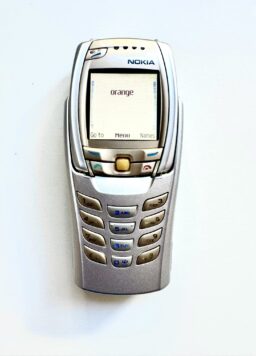
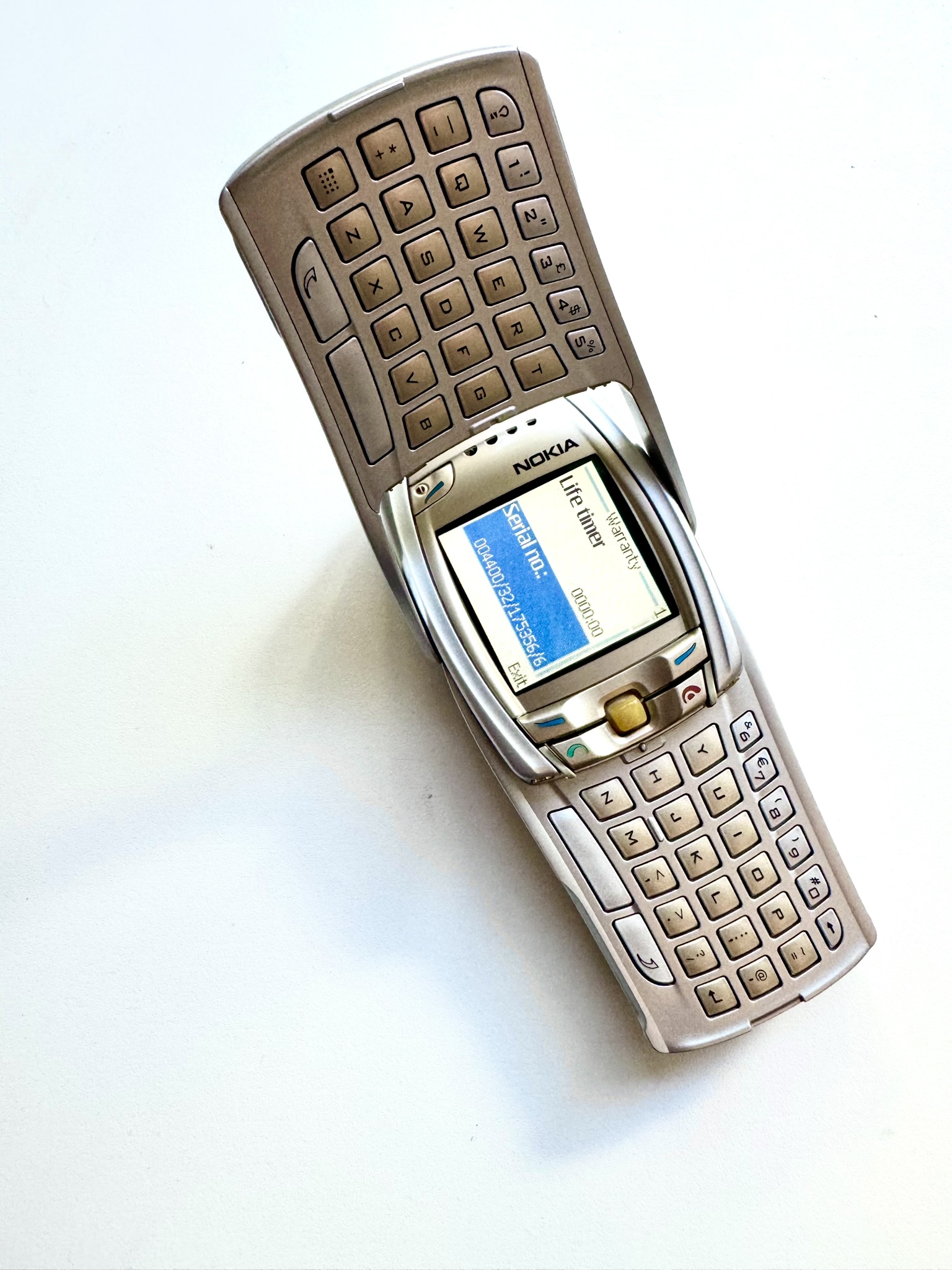
Nokia 6810 Prototype B3.0 : Engineering Sample
Quick ViewA rare early-stage prototype of the Nokia 6810, the business-class messaging phone famous for its fold-out QWERTY keyboard design. This internal test unit predates the commercial RM-2 variant and carries blank “Model XXXX / Type XXXX” fields, together with the unmistakable “Property of Nokia” and B3.0 engineering markings. Built in Finland and never intended for sale, it represents the development phase where Nokia refined the mechanical flip-out keyboard and RF tuning for one of its most innovative business devices.