

">

Showing 1–12 of 13 results
-
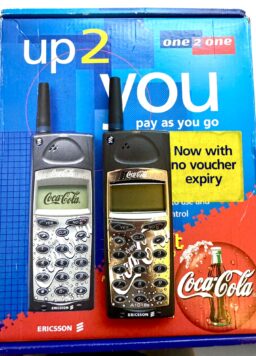
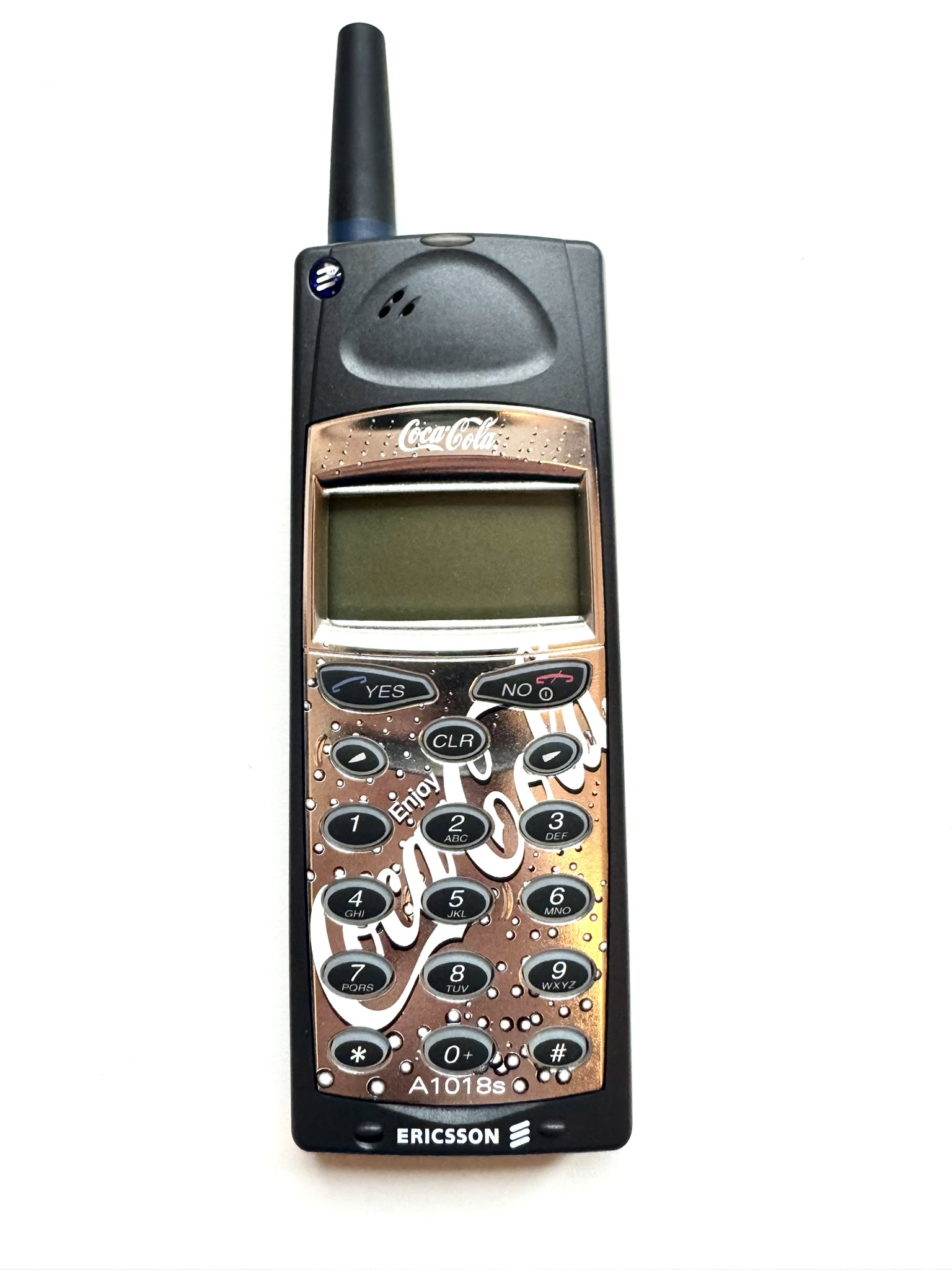
Ericsson A1018s: Coca-Cola Edition The Golden Age of Brand Collaborations
Quick View💎 Rarity Index: A (Rare)
⭐ WOW Factor: Rare Coca-Cola promotional edition with officially designed Coca-Cola fascia
👁 Evaluation in my collection: BNIB – 10/10
⏱ Life timer: 0m | 📦 Boxed: YES
📅 Release Year: 2000 | 💰 Release Price: N/A
📊 Units Sold: ~2k
📰 Why this phone matters: Created during a unique moment when global brands began exploring mobile technology as a marketing medium, the Ericsson A1018s Coca-Cola Edition stands as one of the most iconic promotional phones ever released. Produced in Sweden at the start of the year 2000 and distributed exclusively through Coca-Cola campaigns, it was never sold in stores. Released exclusively through Coca-Cola Great Britain in partnership with the One-2-One network, this phone could not be purchased under any circumstances – instead, it required participants to collect 60 promotional Coca-Cola ring pulls or bottle tokens, attach them to an application sheet, fill out the official Coca-Cola Application Form in block capitals, and mail everything together with a £30 cheque or postal order before the 30 September 2000 cutoff. Approved applications received the phone by post along with a prepaid One-2-One SIM pack and accessories.This edition is instantly recognizable by its factory-issued Coca-Cola fascia – a chrome surface decorated with rising bubble motifs and the flowing “Enjoy” script, perfectly echoing Coca-Cola’s classic advertising themes of the late ’90s and early 2000s. Combined with the elegant black frame and Ericsson’s signature oval keys, the design merges the energy of Coca-Cola branding with the industrial clarity of Ericsson’s pre-Sony mobile philosophy. It retains all the authentic A1018s internals: removable fascia, SMS capability, ringtone composer, and the special Coca-Cola ringtone delivered as part of the official promotional batch.
The full box presentation elevates the rarity even further. The promotional kit includes Coca-Cola branded inserts, themed accessories, original battery, documentation, and the distinctive packaging style documented in collector archives. Preserved in BNIB condition, it maintains the exact look and feel it had the day it left the factory – a true artifact of the era.
More than a mobile device, this edition represents a collaboration between two global icons and one of the most memorable reward-based phone campaigns of the early GSM era. Today, the A1018s Coca-Cola Edition is widely regarded as one of the most desirable and visually unique special editions ever produced.
📝 Reviews when released: Ericssoners 🔗
-


Ericsson A2618s
Quick View💎 Rarity Index: C (Common)
👁 Evaluation in my collection: BNIB – 10/10
⏱ Life timer: 0m | 📦 Boxed: YES
📅 Release Year: 2000 | 💰 Release Price: N/A
📊 Units Sold: ~5M
📰 Why this phone matters: Ericsson A2618 offers WAP and SMS technology, it becomes the fourth Ericsson mobile phone with WAP function (the other belongs to MC218, R320 and R380).Based on a new platform ‘Michelle’, it features a sensuous “S-curve” design and contains the latest developments in software and functionality.
The address book could store up to 100 telephone numbers and associated names in the phone’s memory with voice activated dialling and short cut keypad dialling for the first 9 entries. The call lists recorded the last 20 dialled, answered or missed calls.
The A2618s included time and date functions, an alarm clock, a stop watch, call timers and basic function calculator. It could also send and receive SMS text messages and allowed levels of personalisation by selecting from a range of pre-loaded ring tone melodies, by composing your own ring tone and by changing the external covers.
Three games were also provided on the phone, Tetris, Erix and E-Maze. Finally, limited Internet access was provided to mobile services using the Wireless Application Protocol (WAP) over an SMS bearer.
📝 Reviews when released: Ericssoners 🔗
-
Ericsson ER207 (NTT DoCoMo): Ultra-Rare Japan-Only Release
Quick View💎 Rarity Index: S (Ultra Rare)
⭐ WOW Factor: The Ericsson ER207 is not just rare – it’s a portal into a hidden chapter of mobile history.
👁 Evaluation in my collection: Good – 9/10
⏱ Life timer: N/A | 📦 Boxed: NO
📅 Release Year: 1999 | 💰 Release Price: 200 €
📊 Units Sold: ~60k
📰 Why this phone matters: A remarkable and extremely rare Japan-exclusive Ericsson ER207, produced in August 1999 for NTT DoCoMo’s PDC network. This model was never sold internationally and represents Ericsson’s transitional era when the company tailored unique hardware specifically for the Japanese market – often completely different from their global product line.The ER207 embodies classic late-90s Japanese mobile design: compact, angular, antenna-based and featuring the distinctive “DIGITAL” logo across the display window. Unlike mainstream Ericsson models of the same era, the ER207 employed Japan’s proprietary PDC 800/1500 MHz system, resulting in a device architecture not compatible with GSM and making it fundamentally different from eur;opean Ericsson phones.
Unit is accompanied by original accessories, including the Japan-style hand strap, a collectible piece of its own that reflects the cultural design philosophy of late-90s Japanese phones, where personalization and wearable portability were key features.
This makes the device not just rare – but historically significant as part of the very limited Ericsson-DoCoMo collaboration portfolio.📝 Reviews when released: Ericssoners 🔗
-


Ericsson ER209i (NTT DoCoMo): Ultra-Rare Japan-Only Release
Quick View💎 Rarity Index: S (Ultra Rare)
⭐ WOW Factor: The first i-mode enabled mobile phone for the PDC standard
👁 Evaluation in my collection: Great – 9.5/10
⏱ Life timer: N/A | 📦 Boxed: NO
📅 Release Year: 2000 | 💰 Release Price: N/A
📊 Units Sold: ~50k
📰 Why this phone matters: DoCoMo by Ericsson ER209i’ (hereafter ER209i) is Ericsson’s first i-mode enabled mobile phone for the PDC standard. In Japan, the growth of the mobile Internet market is very strong, and NTT-DoCoMo’s i-mode service contributes to this expansion. The number of subscribers who use the i-mode services is 15,227,000 as of November 26, 2000 (reference to data of NTT-DoCoMo).📝 Reviews when released: Ericssoners 🔗
-


Ericsson GA 628
Quick View💎 Rarity Index: A (Rare)
👁 Evaluation in my collection: Great – 9/10
⏱ Life timer: N/A | 📦 Boxed: NO
📅 Release Year: 1996 | 💰 Release Price: ~50 £ with subscription
📊 Units Sold: ~10M
📰 Why this phone matters: The Ericsson GA628 was the first phone you could easily customise. Every new Ericsson GA628 came with four different front panels in green, yellow, blue or red.📝 Reviews when released: N/A 💔
-


Ericsson GF788e
Quick View💎 Rarity Index: B (Uncommon)
👁 Evaluation in my collection: Great – 9.5/10
⏱ Life timer: N/A | 📦 Boxed: NO
📅 Release Year: 1997 | 💰 Release Price: N/A
📊 Units Sold: ~2.5M
📰 Why this phone matters: The Ericsson GF 788 is a mobile device manufactured by the Ericsson manufacturer . The series was launched in 1997, has since been manufactured and is 105 x 49 x 24 mm in size and weighs 135 grams. The screen is alphanumeric with 1 x 10 character resolution. The Ericsson GF 788 is coded. Ringtones in the future are of this monoponic type . For texting, you can use SMS . The battery is removable, with a NiMH type of 550 mAh capacity and up to 60 hours of standbyand it lasts 180 minutes while calling. Whereas for communication, this router uses GSM networks📝 Reviews when released: N/A 💔
-


Ericsson GH 174
Quick View💎 Rarity Index: A (Rare)
👁 Evaluation in my collection: Very Good – 8.5/10
🕵 Ericsson Codename: Curt
⏱ Life timer: N/A | 📦 Boxed: YES
📅 Release Year: 1992 | 💰 Release Price: ~300 €
📊 Units Sold: ~500k
📰 Why this phone matters: Ericsson’s new GSM digital pocket telephone, the GH172, has now received the ITA (Interim Type Approval) certificate from German authorities. The GH172 has passed all segments of the required testing, and was approved for the digital telephone standard in eur;ope, GSM. Deliveries of the product will begin in Germany in November, 1992. Ericsson’s first GSM phone was a re-engineered version of the similar looking, NH72. N refers to NMT, the old Nordic analogue network, G to GSM and H stands for hand portable/handset. The NH72 was developed from a larger brown and orange creation, Ericsson’s first hand portable, the HotLine Pocket. Nils Rylands, Head of Research at the Ericsson Mobile Telephone Laboratory and his team took a police radio and turned it into a mobile phone. The codename for this project was ‘Curt’. ‘Curt’ broke a long running Ericsson tradition.Up until then, all Ericsson mobile phone research projects had been given female names. The female naming returned for the GH172/NH72, which was called ‘Olivia’. The successor, a slightly updated version GH174, made in white buttons.
📝 Reviews when released: Ericssoners 🔗
-


Ericsson R250s PRO
Quick View💎 Rarity Index: A (Rare)
👁 Evaluation in my collection: Great – 9/10
⏱ Life timer: N/A | 📦 Boxed: NO
📅 Release Year: 2000 | 💰 Release Price: ~300 €
📊 Units Sold: ~400k
📰 Why this phone matters: The R250 PRO dual band phone is also the first mobile phone to support both GSM phase 2+ technology and the GSM Pro system, which will give the users a unique opportunity to combine the advantages of GSM phones with Private Mobile Radio (PMR) functionality. The support of GSM Pro will give the user a unique opportunity to subscribe to features that, so far, have been the privilege of Private Mobile Radio (PMR) users. With the special GSM Pro SIM card, it is possible to use just one number to initiate group calls with up to 16 members.📝 Reviews when released: Ericssoners 🔗
-


Ericsson R290
Quick View💎 Rarity Index: S (Ultra Rare)
⭐ WOW Factor: The most compact satellite phone
👁 Evaluation in my collection: New – 10/10
⏱ Life timer: N/A | 📦 Boxed: YES – SWAP
📅 Release Year: 1999 | 💰 Release Price: N/A
📊 Units Sold: ~120k
📰 Why this phone matters: The Ericsson R290 is a combined GSM and satellite phone using the Globalstar satellite network. The R290 was introduced in June 1999 and manufactured in the United Kingdom by Ericsson Mobile Communications.The Globalstar uses a foldable antenna that is the same length as the body of the telephone. The R290 comes in a blue and black case in a style similar to other Ericsson phones of its period. The case incorporates some Gore-Tex weatherproofing, similar to that used in the Ericsson R310s, although less extensive.
The R290 also has a built-in modem for data and fax communication at 9.6 kbit/s in GSM mode and 7.2 kbit/s in satellite mode.
Ericsson R290 Satellite 002.jpg
The R290 is somewhat larger than typical, pure GSM phones, measuring 162 mm (6.4 in) x 62 mm (2.4 in) x 39 mm (1.5 in) and weighing 350 g (12 oz) (with slim battery). The R290 has relatively brief battery life compared with typical, pure GSM phones of its generation.Because it uses a non-standard battery voltage, its charging connector is not one of the types commonly seen on other Ericsson handsets. The device was capable of detecting over-voltage from inappropriate charging equipment, and warning the user to disconnect the charger.
The R290 spanned the corporate change from Ericsson to Sony Ericsson (when many of Ericsson’s other phones were redesigned), being the only combined GSM and satellite phone in their range; it was not rebranded, however.
📝 Reviews when released: Ericssoners 🔗
-


Ericsson S868: Swedish Bronze Edition
Quick View💎 Rarity Index: A (Rare)
⭐ WOW Factor: One of the first dual-band GSM 900/1800 phones – built for roaming and network resilience.
👁 Evaluation in my collection: As New – 9.8/10
⏱ Life timer: N/A | 📦 Boxed: YES
📅 Release Year: 1998 | 💰 Release Price: ~600 $
📊 Units Sold: ~150k
📰 Why this phone matters: The Ericsson S868 is a legendary late-1990s dual-band GSM phone that pushed mobile communication into a new era of reliability and quality. Introduced by Ericsson in 1998 as a premium dual-band (GSM 900/1800) handset, the S868 delivered enhanced roaming capabilities, robust build quality, and the kind of dependable performance that made it a top choice for business users and world travelers.This unit is fully functional, comes with its full original box, and remains in as-new condition – a rare find for a model built in 1999. Its rare bronze-metallic finish and pristine Swedish-made shell underline the exclusivity of this phone.
Built in week 20 of 1999 in Sweden, this S868 is part of one of the final production runs before Ericsson transitioned to their next-generation series. The original label confirms its eur;opean configuration, dual-band network support, and certification compliance – affirming it as a genuine factory piece rather than a later reproduction or modded unit.
What makes the S868 truly special is its dual-band capability (GSM 900 & GSM 1800), implemented at a time when network congestion was growing rapidly. Ericsson designed the S868 to automatically switch between bands for uninterrupted calls and roaming – a cutting-edge feature in 1998 that many rivals lacked.
The phone also supported the then-high-end Enhanced Full Rate (EFR) speech coding, delivering voice clarity comparable to fixed-line phones.
In a world before smartphones, the S868 offered elegant simplicity and robust functionality: reliable calls across multiple GSM bands, solid build, crisp keypad, clean external antenna, and minimalist design. As a Swedish-made executive-class handset from the twilight of the 1990s GSM era, this S868 stands as a collectible relic of where mobile telephony once stood – before internet browsing, cameras, and data plans.
Whether kept as a pristine collector’s piece or admired for its engineering purity, the S868 remains a symbol of “classic mobile phone” craftsmanship. Its rarity, condition, and historical significance make it more than just a phone – it’s a time capsule of mobile communication’s golden age.
📝 Reviews when released: Ericssoners 🔗
-


Ericsson T28s
Quick View💎 Rarity Index: B (Uncommon)
⭐ WOW Factor: The lightest handset on the market in 1999
👁 Evaluation in my collection: Great – 9.8/10
⏱ Life timer: N/A | 📦 Boxed: NO
📅 Release Year: 1999 | 💰 Release Price: N/A
📊 Units Sold: ~2.5M
📰 Why this phone matters: The T28 was the lightest and slimmest mobile phone at the time, with a weight of only 83 grams.Unlike many mobile phones of the time (1999-2001) it had a fixed, stubby external antenna. It was probably best known as the first phone that used lithium polymer batteries. At one point, it was the best selling mobile phone in America.
In terms of market positioning, Ericsson designated this as a premium phone, as such it was priced substantially higher (often more than triple) the price of the T10 and T18 devices – their nearest cosmetic and functional competitors. It has a tiny LCD screen and an spring-loaded latch mechanism to release the ‘flip.’
Models
Four different versions of the T28 were sold. T28z was compatible with GSM1900 for use in North America. T28s was compatible with GSM900/1800 for use in the rest of the world – this is by far the most common version. T28 World was compatible with GSM900/1900 for use worldwide on GSM900 and North America on GSM1900 (this was the second World phone Ericsson introduced, the first being the I888 which had the distinction of being the first commercially available GSM900/1900 phone). A special version, the T28sc was released in China with support for reading and entering Chinese characters.The device came in three colours-very dark blue, lighter blue and sand. The sand version being the least common.
The device was listed as compatible with two batteries. A normal slim-line and an ultra-slim lower capacity battery. However the device was also battery-compatible with the later R320 and R520 series.
📝 Reviews when released: Profit Warning 🔗
-


Ericsson T28s Marble Beige: The Ultra Slim Business Legend
Quick View💎 Rarity Index: S (Ultra Rare)
⭐ WOW Factor: The lightest handset on the market in 1999
👁 Evaluation in my collection: Great – 9.8/10
⏱ Life timer: N/A | 📦 Boxed: YES
📅 Release Year: 1999 | 💰 Release Price: N/A
📊 Units Sold: ~150k
📰 Why this phone matters: This BNIB Ericsson T28s in Marble Beige stands as one of the finest surviving examples of Ericsson’s late-1990s engineering excellence, preserved exactly as a high-tier executive customer would have received it in 1999. All accessories remain sealed, including original charger, ultra-slim battery, carrying case, headset, and Greek-market manual, confirming the set as fully untouched retail inventory. The handset itself is flawless, showing zero oxidation on the metal hinge, zero aging on the keypad, and a perfectly preserved LCD protective film.Manufactured in Sweden during production week 99W48, this unit belongs to the earliest and most sought-after manufacturing batch, a period when Ericsson’s Scandinavian plants produced their highest-precision casings and hinge systems. The Marble Beige finish, the rarest official color for the T28 range, displays uniform pigment with no signs of yellowing, coating shift, or micro-wear. This particular finish was produced in extremely limited quantities, intended for boutique retail channels and premium corporate contracts rather than mass distribution.
As the lightest mobile phone in the world at launch, weighing only 83 grams, the T28s broke new engineering ground. It was the first commercial handset to utilize lithium polymer battery technology, a breakthrough that allowed Ericsson to achieve its groundbreaking slimness while maintaining strong standby performance. The T28 family helped set the design trajectory for the R320, R380, and later R520 series, all of which inherited its battery architecture and minimalist Scandinavian design language.
The T28s was priced dramatically higher than Ericsson’s T10 and T18 models, often exceeding triple their cost. This was deliberate: the T28s was positioned as a business instrument rather than a consumer phone. Its user base consisted of executives, financial professionals, international travelers, and early mobile adopters who valued style and compactness over mass-market features. In the United States it became one of the most successful premium handsets of its time, appearing in advertising campaigns, airport lounges, and business environments where elegance and miniaturization were the primary selling points.
The hinge mechanism, a defining feature of the T28s, was engineered with a spring-loaded stainless-steel latch designed for long-term durability. Many surviving used devices exhibit hinge fatigue or paint cracking, making BNIB examples exceptionally rare. This unit’s hinge remains factory-tight, demonstrating the precision of Swedish production during the late 1990s.
Additionally, the T28s was one of Ericsson’s earliest phones to implement a multi-market strategy with multiple radio variants: T28s for international GSM900/1800, T28z for GSM1900 North America, T28 World for GSM900/1900 dual-band, and T28sc for the Chinese character market. Among these, the T28s Marble Beige remains the most elusive due to its limited distribution and fragility of finish. Collectors widely consider Marble Beige the crown jewel of the T28 line, especially in factory-fresh condition.
With all documentation intact, sealed accessories, and a pristine handset untouched since production, this set stands as a museum-grade time capsule from the era when eur;opean engineering dominated mobile phone design. It captures the technological threshold between classic feature phones and the upcoming intelligent device revolution, making it one of the most historically meaningful Ericsson collectibles in existence.
📝 Reviews when released: Profit Warning 🔗