

">

Showing 1–12 of 20 results
-
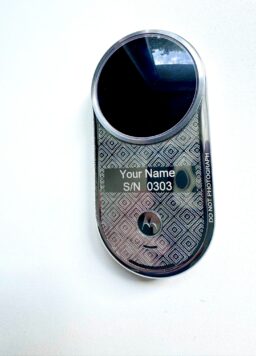
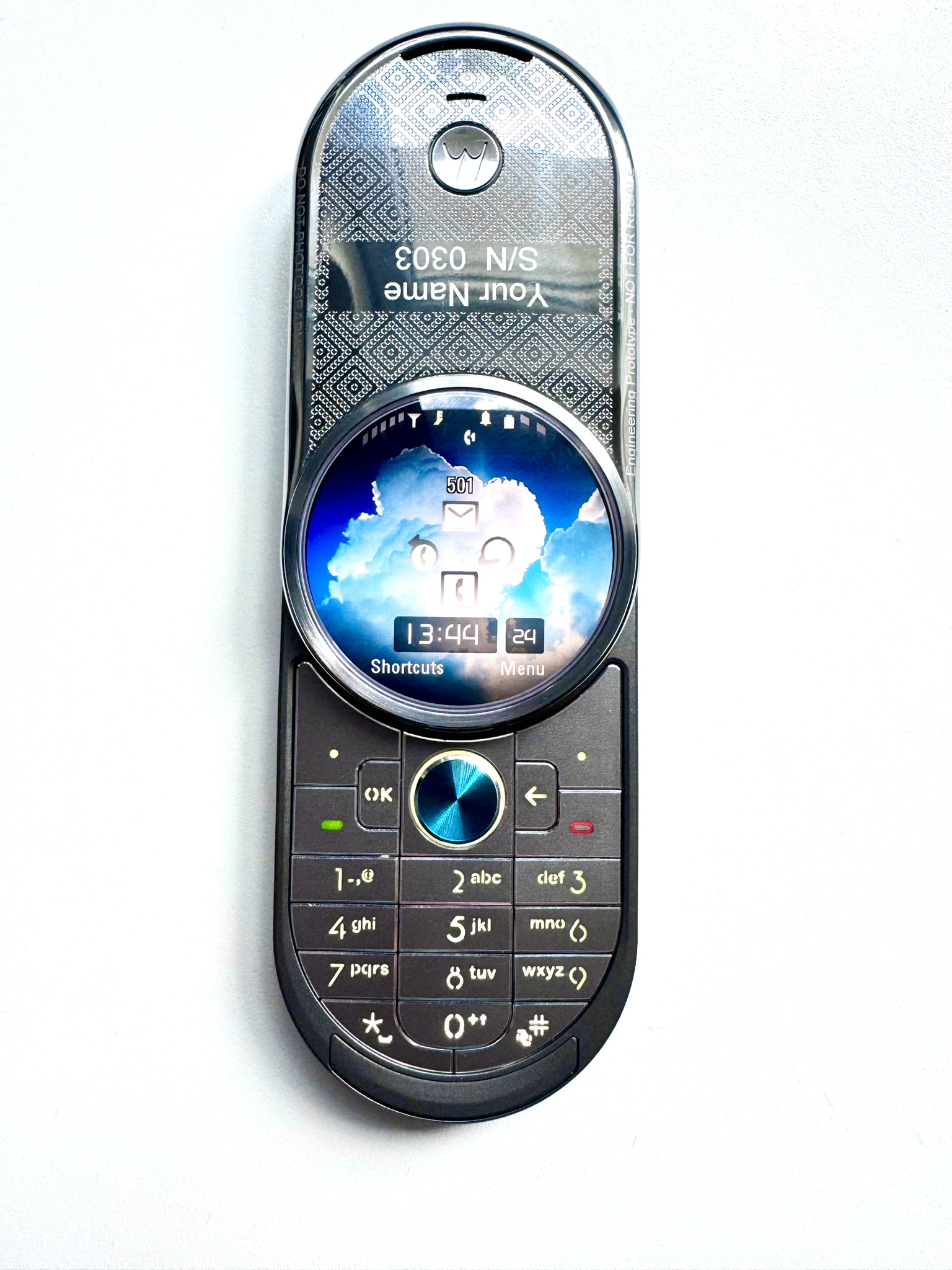
Motorola Aura R1 Unreleased Prototype : Engineering Design S/N 0303
Quick View💎 Rarity Index: X (Mystical Prototype)
⭐ WOW Factor: Saphire glass, stainless steel, swivel like opening mechanism, Swis Made gears for the mechanism.
👁 Evaluation in my collection: Great – 9.5/10
⏱ Life timer: N/A | 📦 Boxed: NO
📅 Release Year: 2008 | 💰 Release Price: ~2000$
📊 Units Sold: 0
📰 Why this phone matters: A masterpiece from Motorola’s most ambitious luxury project, this is an extremely early pre-production Aura prototype, created before the final 2008 model and never meant to leave the design labs. It carries full engineering markings – “Prototype – Not For Resale”, “Do Not Photograph”, and a personalized engineer-assigned S/N (0303) – making it a true artifact of Motorola’s internal design history.Unlike the retail Aura, this prototype features a unique diamond-etched metal housing, a larger mechanical gear window, unreleased keypad styling, and early internal board architecture. It represents the original mechanical vision for the Aura’s iconic rotating display mechanism – built more like a Swiss watch movement than a phone.
Surviving prototypes of the Aura are almost mythical.
One with unreleased design, internal engraving, and full confidentiality markings is beyond rare – a museum-level piece and a highlight for any high-end mobile collection.📝 Reviews when released: Cnet.Com 🔗
-


Motorola Aura R1: The Motorola Crownpiece
Quick View💎 Rarity Index: A (Rare)
⭐ WOW Factor: Saphire glass, stainless steel, swivel like opening mechanism, Swis Made gears for the mechanism.
👁 Evaluation in my collection: Great – 9.5/10
⏱ Life timer: N/A | 📦 Boxed: NO
📅 Release Year: 2008 | 💰 Release Price: ~2000$
📊 Units Sold: ~20k
📰 Why this phone matters: This unit is a Motorola Aura R1, one of the most mechanically advanced and visually distinctive luxury phones ever produced. Released in late 2008 as part of Motorola’s ultra-premium 4LTR line, the Aura was created not to compete with emerging smartphones, but to demonstrate the highest possible level of industrial craftsmanship, materials engineering, and mechanical design. The Aura is widely recognized as the final true mechanical masterpiece from Motorola before the touchscreen era ended the age of such devices.This particular unit is from the Australian market and is labeled simply as R1 rather than carrying the full Aura branding on the regulatory sticker. This detail is a documented regional distinction: Australian-market units were typically marked R1 only, while eur;opean units often carried the full “Aura” designation. For collectors, this is an important variant because it shows how Motorola adapted the labeling conventions for certain regions while retaining the exact same premium hardware. The unit is in as-new condition, showing minimal or no signs of use, making it highly desirable for collectors given the mechanical nature of the device and the low survival rate of pristine examples.
The Aura’s defining features remain extraordinary even today. Its iconic circular display offers 300 dpi resolution, protected by a 62-carat sapphire crystal lens cut and polished with extremely low-yield manufacturing processes. The sapphire window is among the most premium and expensive components ever mass-produced for a mobile device. The circular screen required Motorola to heavily modify its MotoMagx Linux platform, creating a custom UI layer and a unique rotational visual experience matched to the mechanical opening motion.
The rotating front mechanism is a mechanical achievement unmatched by any other production phone. Built with more than 200 precision-machined components, 130 micro ball bearings, and Swiss-made hardened steel gears, the hinge delivers a controlled, watch-like motion engineered to remain consistent over thousands of rotations. The metal surfaces use coatings derived from high-performance racing engines, and tolerances within the rotational assembly reach watchmaking precision levels. These characteristics place the Aura closer to horology than consumer electronics.
Constructed from surgical-grade stainless steel, the Aura R1 features hand-machined finishing, a weighty and solid feel, and a premium tactile character that cannot be replicated with modern materials. Despite its luxurious build, it retains practical functions: quad-band GSM, Bluetooth, a 2 MP camera, microSD support, custom audio themes, and a refined circular UI layout. At launch, the Aura sold for approximately 2000 $, reflecting both its engineering cost and its intended role as a luxury lifestyle object rather than a mass-market handset.
Because production was extremely limited and the device was released during the iPhone-driven smartphone revolution, few Aura units were manufactured, and even fewer survive in excellent mechanical condition. Many suffered rotational mechanism wear, sapphire damage, or cosmetic deterioration. As-new units, even without the original box, are very rare and increasingly valued as the Aura’s reputation continues to grow among collectors.
This unit represents one of the most iconic expressions of Motorola’s industrial design heritage. With its as-new presentation, Australian-market R1 label variant, circular sapphire display, watch-grade rotating mechanism, and stainless-steel construction, it stands as a top-tier collectible luxury phone. It captures a unique moment when mechanical artistry, materials science, and mobile technology converged to produce a device unlike anything before or since. The Aura R1 remains one of the most extraordinary and desirable non-smartphone luxury handsets ever made.
📝 Reviews when released: Cnet.Com 🔗
-
Motorola E18 Ivory Unreleased Prototype: The Lost Luxury
Quick View💎 Rarity Index: X (Mystical Prototype)
Ultra expensive luxury phone after Aura
👁 Evaluation in my collection: 9/10 – 10/10
⏱ Life timer: N/A | 📦 Boxed: NO
📅 Release Year: 2008 | 💰 Release Price: ~2000
📊 Units Sold: 0 unreleased
📰 Why this phone matters: The Motorola E18 Ivory is one of the rarest and most intriguing unreleased devices ever created by Motorola. Designed as a luxury slider phone with high-end materials and a unique dual-stop sliding mechanism, the E18 represented a bold and experimental direction that Motorola never brought to market. This prototype was intended to compete in the ultra-premium segment, with the stainless steel production version carrying a projected retail price of around 2000 eur;, placing it far above standard Motorola models of the era.This unit is an Ivory prototype in mint, as new, fully working condition, making it an exceptionally rare survivor. Very few E18 units were ever completed, and prototypes were typically scrapped, destroyed, or left non-functional. Having a working device in such preserved condition is considered unicorn-level rarity among Motorola collectors.
The defining feature of the E18 is its dual-stop slider mechanism. The first sliding step reveals a set of function keys, while the second sliding step exposes the complete T9 keypad. This layered mechanical design is unlike any mass-produced Motorola phone and reflects a level of engineering experimentation seen only in internal development devices. The combination of compact size, premium detailing, and complex mechanical motion makes the E18 one of the most innovative unreleased designs Motorola ever attempted.
Equipped with a 3 MP camera, premium external materials, and a sleek luxury aesthetic, the E18 Ivory was planned as a flagship device aimed at high-end buyers. Its design blends minimalist clean lines, luxury cues, and an advanced sliding system that offers a distinct tactile experience. The overall look and feel suggest that Motorola intended the E18 to stand alongside boutique luxury brands rather than mainstream consumer models.
Because the E18 project was cancelled before launch, surviving prototypes are extremely scarce. Most did not reach a stable operational state or were never finished to production quality. A mint, fully operational Ivory prototype is almost impossible to find, and it represents one of the most important pre-production artifacts in Motorola’s history. This device stands as a rare window into a luxury direction the company never pursued, making it a true collector trophy and a highlight in any high-end mobile phone collection.
📝 Reviews when released: PhoneArena.com 🔗
-


Motorola VE66
Quick View💎 Rarity Index: B (Uncommon)
👁 Evaluation in my collection: BNIB – 10/10
⏱ Life timer: 0m | 📦 Boxed: YES
📅 Release Year: 2008 | 💰 Release Price: ~250 €
📊 Units Sold: ~1M
📰 Why this phone matters: VE 66 had the MotoMagx which is a Linux kernel-based mobile operating system developed and launched in 2007 by Motorola to run on their mid-to-high-end mobile phones. The system is based on MontaVista’s Mobilinux. Originally intended for the 60% of their upcoming devices, it was soon dropped in favor of Android and Windows Mobile operating systems.📝 Reviews when released: N/A 💔
-

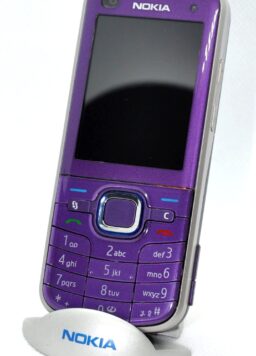
Nokia 6220 Classic
Quick View💎 Rarity Index: B (Uncommon)
👁 Evaluation in my collection: Great – 10/10
🕵 Nokia Codename: Astro
⏱ Life timer: 60h | 📦 Boxed: NO
📅 Release Year: 2008 | 💰 Release Price: N/A
📊 Units Sold: ~3M
📰 Why this phone matters: Nokia 6220 classic is a Symbian OS smartphone announced by Nokia on 11 February 2008. It is notable for featuring a Xenon flash for its 5-megapixel camera, similar to the Nokia N82 and often considered as a “budget” version of the N82. Despite its compact size, it offers features comparable the Nseries lineup, although lacks Wi-Fi or a 3.5 mm audio jack, probably to cut costs.📝 Reviews when released: cNET 🔗
-


Nokia 6600 Fold
Quick View💎 Rarity Index: C (Common)
👁 Evaluation in my collection: Brand New Swap – 10/10
⏱ Life timer: 0m | 📦 Boxed: NO
📅 Release Year: 2008 | 💰 Release Price: ~270 €
📊 Units Sold: ~1M
📰 Why this phone matters: There’s no denying that Nokia’s 6600 Fold is eye-catching. Its glossy metal surface and two-tone colouring are bound to stand out on the wall of a mobile phone store amongst the masses of cloned black-plastic handsets. Unlike many flip phones, the Fold is spring loaded and held in place by magnets. On the left side is a ‘one-touch’ opening key that disengages the magnets and flings the top half of the phone upwards. As ridiculous as this sounds there is something genuinely satisfying about answering a call this way.📝 Reviews when released: Mobile Review 🔗
-


Nokia 6650 Fold
Quick View💎 Rarity Index: B (Uncommon)
⭐ WOW Factor: Manufactured only for T-Mobile and AT&T
👁 Evaluation in my collection: Very Good – 9/10
🕵 Nokia Codename: Kenny
⏱ Life timer: 153h | 📦 Boxed: YES
📅 Release Year: 2008 | 💰 Release Price: ~300 €
📊 Units Sold: ~1M
📰 Why this phone matters: The Nokia 6650 fold (also known as the 6650d) is a Nokia smartphone announced in March 2008, running Symbian OS. It is a Hex-band unit using GSM 850, 900, 1,800, and 1,900 MHz networks and UMTS 850 and 2,100 Mhz networks (WCDMA/ HSDPA). Also noted as a quad-band clamshell 3G smartphone, it was released in June 2008. It was sold through AT&T Mobility in the U.S. It is AT&T’s replacement for the S60-powered N75. It was manufactured in three colors, metallic silver, black, and red. It was never a global model, and therefore it was sold exclusively for T-mobile networks in eur;ope.Models were RM-324 for North America and RM-400 for eur;ope.📝 Reviews when released: Mobile Review 🔗
-
Nokia 7070 Prism Prototype S2.1: The Prism Collection
Quick View💎 Rarity Index: S (Ultra Rare)
👁 Evaluation in my collection: As New – 10/10
⏱ Life timer: | 📦 Boxed: NO
📅 Release Year: 2008 | 💰 Release Price: ~230 €
📊 Units Sold: ~1.5M (final units)
📰 Why this phone matters: A genuine pre-production Nokia 7070 Prism – RH-116 prototype from the SCORPION design family, used during Nokia’s hardware and software validation cycle. This engineering sample features a prototype IMEI (004401?), PSN labeling, exposed HWID (0211), and the rare ‘Kiev S2-1’ internal test sticker.Manufactured in China as part of Nokia’s early prototype assembly runs, the device was then shipped to Nokia’s Kyiv (Ukraine) R&D validation center, where Software Stage 2 (S2) firmware and first-revision hardware (Substage 1) were tested for CIS-region operators. This China-production + Kyiv-testing pipeline was standard for Nokia’s mid-2000s development workflow and confirms the device’s authentic R&D provenance.
Fitted with an original Nokia ‘Market Sample’ back housing used for pre-launch demonstrations and retail previews, still carrying factory protective film. A rare SCORPION prototype combining true engineering hardware, regional R&D testing history, and pre-market cosmetic hardware – one of the most collectible 7070 Prism variants ever found
📝 Reviews when released: Phone Arena 🔗
-


Nokia 7100 Supernova
Quick View💎 Rarity Index: C (Common)
👁 Evaluation in my collection: Great – 9.5/10
⏱ Life timer: 14h | 📦 Boxed: NO
📅 Release Year: 2008 | 💰 Release Price: ~100 £
📊 Units Sold: ~2M
📰 Why this phone matters: The 7100 is a slider with a mechanism that thunks nicely and feels solid enough to remain reliable over time. The numberpad, revealed when the slide is up, comprises large-ish buttons with a no frills design. Each button is slightly raised in its centre making it easy to find and hit. With the slide closed this isn’t quite as small as I generally like slider phones to be. It is a bit tall at 98mm. However, its 48.4mm of width and 15mm of thickness are OK. With the slide opened the 7100 is 125mm tall and as for weight, it tips the scales at 103.5g.The casing is made of plastic, which might not stand too many drops down the stairs or crunches in a bag. As for its colour scheme, the 7100 looks designed to appeal to a young and bling-friendly audience. The front fascia is mostly black with, in the case of my review sample, a flash of bright metallic pink sitting below the screen. The back of the casing is also pink. Nokia calls this colour ‘jelly red’ but it looks pink to me. You can also get it in a rather nice shade of blue as well as an almost all black guise with just a flash of blue round the navi button.
The colour splash is where you’ll find the two softkeys and Call and End keys, the latter doubling as the main on/off switch. The navi button is large and its frame is also sizeable. I’d say even those with really stubby fingers should be able to get around this handset fine.
📝 Reviews when released: cNET 🔗
-
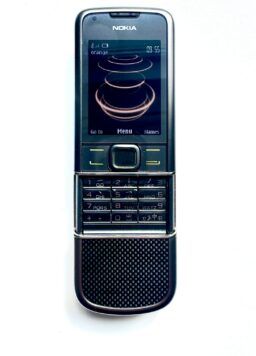
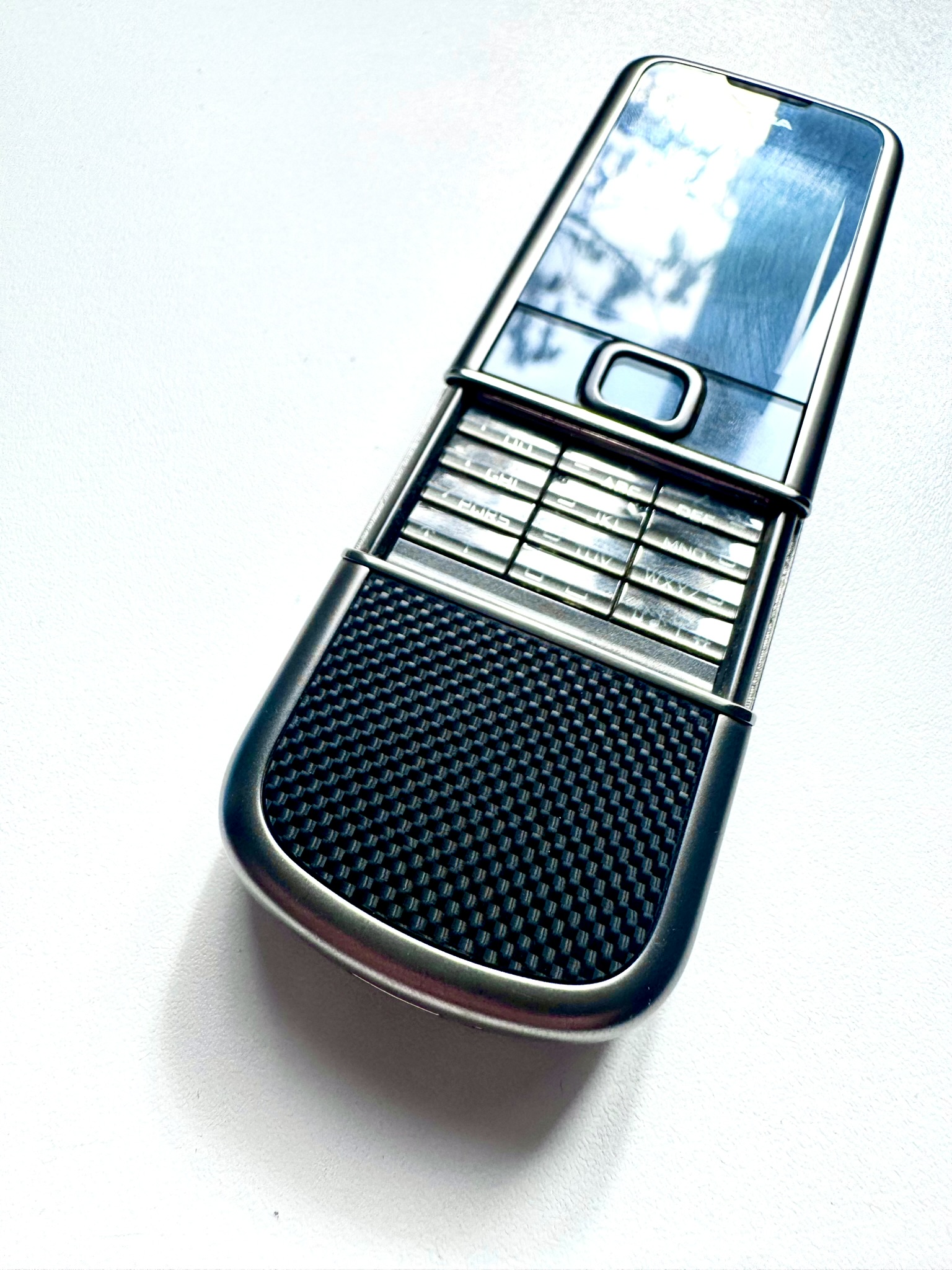
Nokia 8800 Arte Carbon
Quick View💎 Rarity Index: A (Rare)
⭐ WOW Factor: The slider plate is real carbon fiber, not printed texture.
👁 Evaluation in my collection: Great – 9/10
🕵 Nokia Codename: Skira
⏱ Life timer: 83h | 📦 Boxed: NO
📅 Release Year: 2008 | 💰 Release Price: ~1500 €
📊 Units Sold: ~300k
📰 Why this phone matters: Nokia 8800 Carbon Arte (RM-233) – released in 2008 as one of Nokia’s most prestigious luxury devices. Built with real carbon fiber, a titanium-tinted stainless steel frame, scratch-resistant glass and a precision slider mechanism. Equipped with a 4GB internal storage, OLED display and tap-to-time gesture, the Carbon Arte stands at the top of Nokia’s Arte luxury line. A rare and highly collectible model📝 Reviews when released: Mobile Review 🔗
-


Nokia 8800 Arte Classic Black
Quick View💎 Rarity Index: B (Uncommon)
👁 Evaluation in my collection: Great – 9/10
🕵 Nokia Codename: Skira
⏱ Life timer: 21h | 📦 Boxed: NO
📅 Release Year: 2008 | 💰 Release Price: ~1000 €
📊 Units Sold: ~600k
📰 Why this phone matters: Nokia describes the composition of the latest 8800 as a “unique synthesis of high quality glass and metal”, however, unique seems a misnomer considering how similar the Arte looks to its predecessor the Sirocco. That said, there’s definitely something alluring about the simple elegance of the Arte.The 8800 feels great to hold and to use. It’s noticeably heavier than other handsets, and while we’d often mark the extra heft as a bad point, the Arte has a pleasing weight; it feels solid and durable. The sliding mechanism is amongst the best we’ve used, and again gives the impression of a high quality build and of a level of craftsmanship absent from cheaper mass-produced models.
📝 Reviews when released: Mobile Review 🔗
-
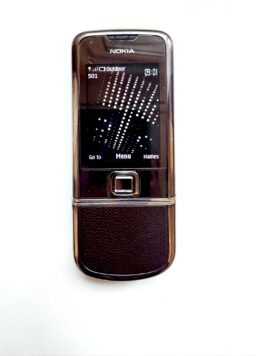
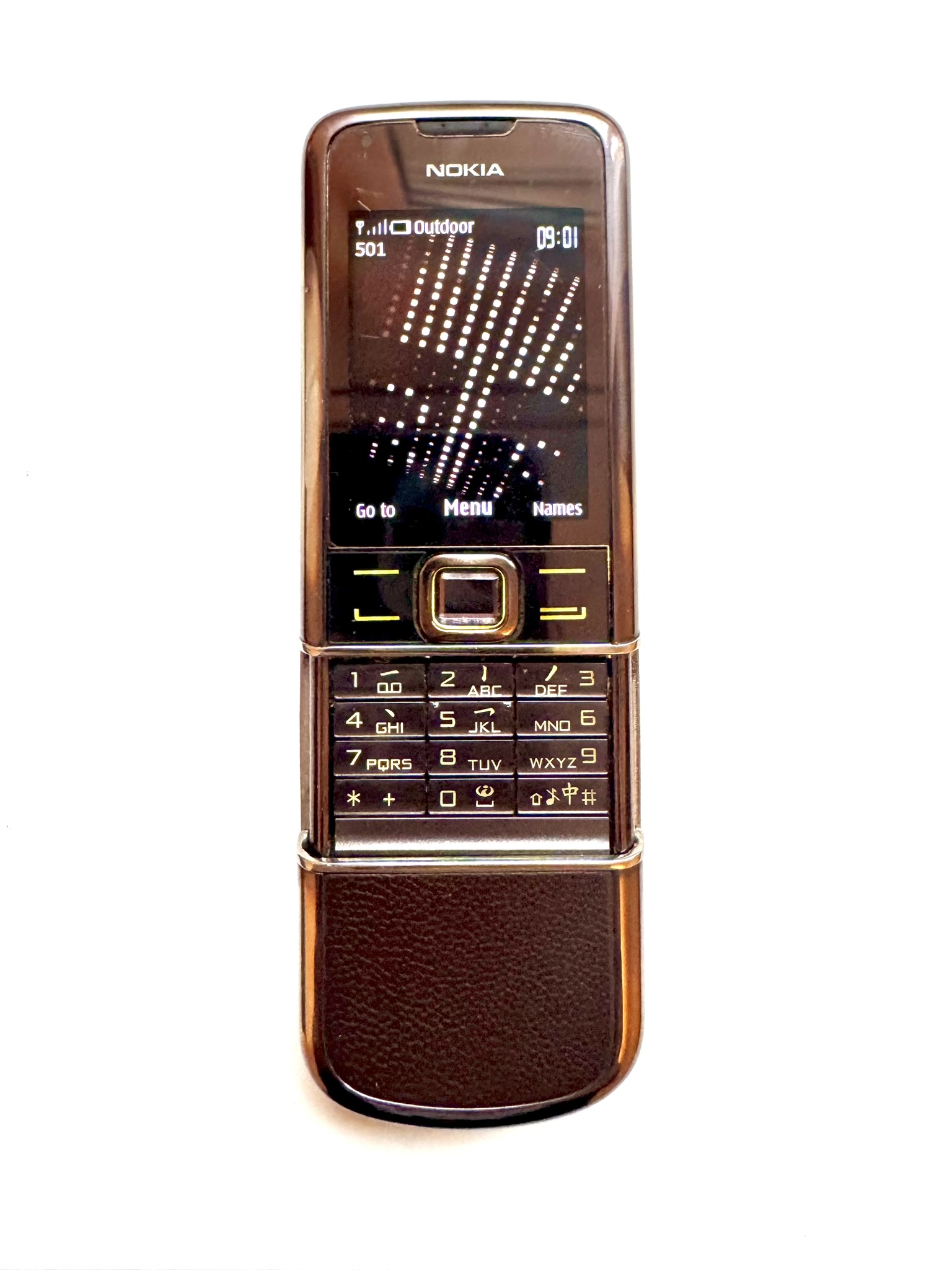
Nokia 8800 Arte Saphire Prototype
Quick View💎 Rarity Index: S (Ultra Rare)
⭐ WOW Factor: The central key uses real sapphire crystal, extremely scratch-resistant.
👁 Evaluation in my collection: Great – 9/10
🕵 Nokia Codename: Skira
⏱ Life timer: 83h | 📦 Boxed: NO
📅 Release Year: 2008 | 💰 Release Price: ~1500 €
📊 Units Sold: ~300k (final units)
📰 Why this phone matters: Nokia 8800 Sapphire Arte (RM-461) – the China-market edition of Nokia’s luxury Arte line, featuring a genuine sapphire crystal navigation key, real brown leather back cover, stainless-steel frame and the elegant mocha-brown titanium finish specific to this variant. Built in 2008 with a 1GB internal memory layout and the premium Series 40 Arte interface, this model was engineered for the Asian GSM market and operates on regional 2G frequencies (900/1800), unlike the global 8800e models which use quad-band hardware. Part of Nokia’s final luxury slider family, the Sapphire Arte remains one of the most refined and collectible 8800 variants ever produced📝 Reviews when released: Mobile Review 🔗