

">

Showing all 6 results
-


B&O 9600
Quick View💎 Rarity Index: S (Ultra Rare)
👁 Evaluation in my collection: Very Good – 9/10
⏱ Life timer: N/A | 📦 Boxed: NO
📅 Release Year: 1996 | 💰 Release Price: N/A
📊 Units Sold: ~15k
📰 Why this phone matters: Telephones are for speaking into and for listening to, but why stop at that? When Bang & Olufsen developed their own, they were built on the accumulated knowledge of natural sound, the durability of materials and of logical operation and function.BeoCom 9600 was a GSM mobile phone in a class of its own as far as materials, manufacture and function were concerned. In spite of its unassuming appearance, it gave the user a loud and clear connection, even in noisy environments and with a card for fax and PC, it gave total mobility.
📝 Reviews when released: BeoWorld 🔗
-


Ericsson GA 628
Quick View💎 Rarity Index: A (Rare)
👁 Evaluation in my collection: Great – 9/10
⏱ Life timer: N/A | 📦 Boxed: NO
📅 Release Year: 1996 | 💰 Release Price: ~50 £ with subscription
📊 Units Sold: ~10M
📰 Why this phone matters: The Ericsson GA628 was the first phone you could easily customise. Every new Ericsson GA628 came with four different front panels in green, yellow, blue or red.📝 Reviews when released: N/A 💔
-


Motorola StarTAC 70 “Rainbow Edition”: The Ultra-Rare Multicolor Icon of the GSM Era
Quick View💎 Rarity Index: S (Ultra Rare)
⭐ WOW Factor: A factory-produced StarTAC in full multicolor Rainbow livery is one of the most elusive special editions Motorola ever released.
👁 Evaluation in my collection: BNIB – 10/10
⏱ Life timer: N/A | 📦 Boxed: YES
📅 Release Year: 1996 | 💰 Release Price: More than 1000 $
📊 Units Sold: ~30k
📰 Why this phone matters: The Motorola StarTAC 70 Rainbow Edition is not just rare, it is one of the hardest to find and most aggressively hunted special editions ever created in the StarTAC lineage. Even among collectors of 90s GSM icons, the Rainbow sits in a tier of its own, a true ultra variant that almost never appears in genuine form. While over 60 million StarTACs were sold worldwide, the authentic Rainbow Edition represents a microscopic fraction of production, making it one of Motorola’s most elusive and valuable designs.Born from Motorola’s brief but daring attempt to break into the youth market, the Rainbow Edition abandoned every established rule. Instead of corporate black, it exploded in a palette of red, green, blue and yellow molded plastics. This was not a repaint or a gimmick. These colors were factory produced, region specific, and offered only in small numbers through select operators such as MoviStar and Telefonica. The visual impact was radical, and at a time dominated by monochrome Nokia bricks, this phone looked like nothing else on Earth.
The Rainbow was a commercial anomaly, too bold for the mainstream and too ahead of its time for conservative users, and because of that, extremely few survived. Its scarcity has driven collectors into near obsessive authentication hunts, especially with the flood of counterfeits and repainted shells that appeared over the years. Genuine units, with original multi tone housings and correct operator branding, are considered trophy level acquisitions.
This device is BNIB and fully functional, preserved in a condition that is virtually unheard of for this variant. And even more extraordinary, there are two BNIB Rainbow StarTAC 70 units in the collection. Owning even one authentic Rainbow is already almost impossible. Having two boxed originals elevates the rarity to a level normally reserved for museum archives or private corporate vaults.
The original box, with its dramatic rainbow arc and cosmic blue background, was produced only for this version, reinforcing how intentionally Motorola treated this colorway. Everything about this edition was designed to break conventions and redefine what a mobile phone could look like.
Today, the StarTAC 70 Rainbow Edition is considered one of the most desirable, visually unique and aggressively rare special editions ever created in the early GSM era. It is not just a phone, it is a declaration of design rebellion, a historical anomaly, and a centerpiece for any serious collector of mobile icons.
📝 Reviews when released: N/A 💔
-


Motorola StarTAC 70: The Early Grey Flip Legend
Quick View💎 Rarity Index: B (Uncommon)
⭐ WOW Factor: First ever clamshell mobile
👁 Evaluation in my collection: Great – 9/10
⏱ Life timer: N/A | 📦 Boxed: NO
📅 Release Year: 1996 | 💰 Release Price: More than 1000 $
📊 Units Sold: ~4M
📰 Why this phone matters: The Motorola StarTAC 70 stands as one of the earliest and most historically significant variants of the legendary StarTAC family, the first true clamshell (flip) mobile phone ever released. Introduced shortly after the landmark 1996 launch, the StarTAC 70 preserved the original revolutionary design while offering improved digital GSM functionality, refined internal boards, and sturdier mechanical tolerances compared to the earliest production runs. It belongs to the foundational generation of StarTAC devices that bridged the analog-to-digital transition and helped define the identity of the modern mobile phone.This particular unit is in mint condition, fully working, and comes with a matching rare grey external battery. Grey StarTAC phones were produced in far lower quantities than the classic black versions, and grey batteries were even scarcer, often sold regionally or in limited early batches. Finding both components in matching grey and in such well-preserved condition is uncommon, placing this device among the rarer StarTAC 70 configurations still surviving today.
The StarTAC 70 retains the pure early design language that collectors value. Unlike later variants such as the StarTAC 85 or 130, which introduced more standardized housings and updated internal structures, the 70 is mechanically closer to the original 1996 models. It features the earlier-generation hinge architecture, slimmer battery rails, pre-2000 internal plastics, and the original tactile keypad dome sheets that defined the early StarTAC experience. These traits make it a more authentic representation of the original engineering philosophy.
Historically, the StarTAC series reshaped the global mobile market, becoming one of the first phones to achieve true mainstream popularity. With more than 60 million units sold, the design became iconic, influencing nearly all clamshell phones released during the late 1990s and early 2000s. The StarTAC’s upward-folding flip mechanism was the evolutionary successor to the MicroTAC and became the foundation of Motorola’s global dominance. In 2005, PC World ranked the StarTAC as one of the 50 greatest gadgets in history, underscoring its impact on consumer electronics.
The StarTAC 70 sits at a key point in this evolution. It helped solidify the device’s reputation during the early expansion of GSM networks, delivering the compactness, superb RF performance, and minimalist industrial design that made Motorola the preferred brand for business users of the time. Its perfectly balanced hinge action, clean clamshell silhouette, and ultra-portable size embody the design purity of the early StarTAC models before later variants pursued broader mass-market refinements.
As a mint-condition, fully functional example with a rare matching grey battery, this StarTAC 70 is an exceptional collector piece. Most surviving units have worn housings, hinge looseness, cracked antenna plastics, or mismatched batteries. A preserved, uniform grey configuration with flawless operation is exceedingly difficult to find. This unit captures a major historical moment in mobile engineering, representing one of Motorola’s most influential designs and the early era of compact digital GSM phones.
The StarTAC 70 remains a cornerstone of 1990s mobile history. Its significance lies not just in its rarity or preserved state, but in its direct connection to the original StarTAC architecture that forever changed mobile device design. For collectors, this mint grey StarTAC 70 with matching external battery stands as one of the finest surviving examples of Motorola’s early clamshell innovation.
📝 Reviews when released: N/A 💔
-
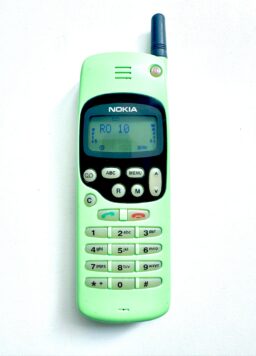

Nokia 1610
Quick View💎 Rarity Index: C (Common)
👁 Evaluation in my collection: Great – 9/10
⏱ Life timer: N/A | 📦 Boxed: YES
📅 Release Year: 1996 | 💰 Release Price: N/A
📊 Units Sold: ~10M
📰 Why this phone matters: Nokia 1610 is a mobile phone model manufactured by Nokia. It complemented the Nokia 2110 business model, but had significantly fewer features. It was introduced in April 1996 and released in May and became highly popular at the time.
The phone had a monochromatic display which could show two rows of text at a time. The operating manual did not mention a possibility to send text messages, but at least units sold from 1996 and onwards included the function. The SMS capable version was called 1610 Plus. The phone used an external rigid antenna, but had a groove on the inside of the battery to accommodate a pull-out type antenna. The 1610 used a credit card size SIM-card, and was powered by a NiMH type battery with a capacity of 600 mAh.📝 Reviews when released: N/A 💔
-


Nokia 9000 Communicator
Quick View💎 Rarity Index: A (Rare)
⭐ WOW Factor: The earliest smartphone on the market
👁 Evaluation in my collection: Great – 9.5/10
⏱ Life timer: N/A | 📦 Boxed: NO
📅 Release Year: 1996 | 💰 Release Price: ~1000 $
📊 Units Sold: ~250k
📰 Why this phone matters: The Nokia 9000 Communicator was the first product in Nokia’s Communicator series, announced at CeBIT 1996 and introduced into the market on 15 August 1996.The phone was large and heavy at 397 grams (14.0 oz) but powerful at the time. It is powered by an Intel 24 MHz i386 CPU and has 8 MB of memory, which is divided between applications (4 MB), program memory (2 MB) and user data (2 MB).The operating system is PEN/GEOS 3.0. The Communicator is one of the earliest smartphones on the market,after the IBM Simon in 1994 and the HP OmniGo 700LX, a DOS-based palmtop PC with integrated cradle for the Nokia 2110 cellular phone, announced in late 1995 and shipped in March 1996.
It was highly advanced, featuring sending and receiving e-mail and fax via its 9.6 kbit/s GSM modem, and it also had a web browser and business programs. The Communicator is formed of a clamshell design that opens up to reveal a monochrome LCD display with a 640×200 resolution and a full QWERTY keyboard similar to a Psion PDA. It was priced £1,000 in the UK upon launch. Then-CEO of Nokia, Jorma Ollila, said in 2012 regarding the device: “We were five years ahead.”📝 Reviews when released: N/A 💔