Showing 13–21 of 21 results
-
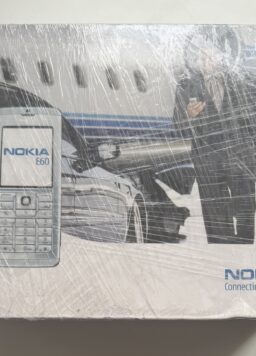
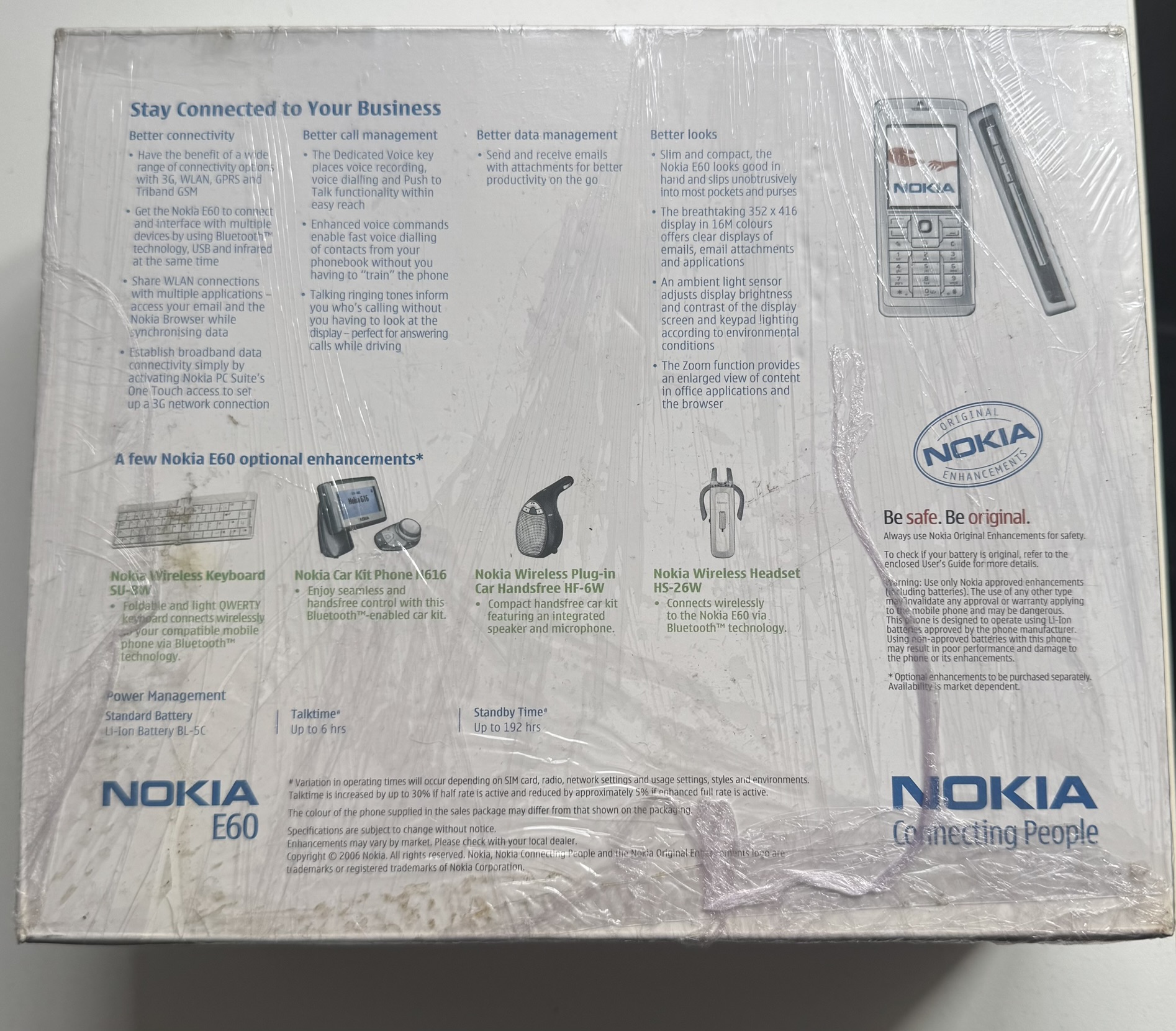
Nokia E60: Sealed Australia Variant BNIB
Quick ViewThis unit is an exceptionally rare sealed Nokia E60 from the Australia market, preserved in untouched BNIB condition. The E60 was Nokia’s pure business flagship, a Symbian S60 3rd Edition device built without a camera for use in secure enterprise environments, from financial institutions to restricted industrial sites. The large 352×416 display, metal construction and corporate-grade hardware defined the early Eseries approach to mobile productivity.
As an Australia variant, this unit carries the region’s specific labeling and certification marks, reflecting Nokia’s APAC distribution of enterprise devices. Nearly all E60 phones were deployed in heavy-use corporate environments, making sealed retail examples virtually impossible to find today. This unopened box protects a complete and unhandled device exactly as it left Nokia’s distribution pipeline, complete with its regional accessories and packaging.
For collectors, the sealed condition elevates this E60 into a true time capsule: a high-spec business smartphone from an era when Nokia dominated enterprise mobility. Its camera-free design, powerful connectivity suite and advanced VoIP capabilities made it a unique hardware configuration even when new, and today it stands as one of the most elusive Eseries devices to acquire in untouched form.
-
Nokia E61 Prototype B3.0 : The “Smailer” | Unreleased Rare Black and Silver colour
Quick ViewThis unit is a remarkable historic artefact: a prototype Smailer RM-89 hardware build of the Nokia E61, finished in an unreleased two-tone silver and black housing that never reached consumer production. The color layout is unlike any retail E61, combining a silver frame with a black upper section and a unique keypad palette that does not exist on final units. The keypad itself uses a mixed color scheme reminiscent of the later E62 look, but with a configuration that was never approved for market release.
Inside the casing you find the clearest testimony to its origin: model field XXXX, prototype build B3, product code 0523307, internal R&D IMEI beginning with 004400, and full Property Of Nokia, Not For Sale, Made In Finland labeling. This confirms the phone as an authentic preproduction engineering unit created during early development cycles before cosmetic design and final materials were locked down.
Externally the device presents the full QWERTY keyboard layout, 5-way joystick and wide landscape display that defined the E61 family. Yet this prototype stands apart because of its unreleased finish: a rare two-tone silver and black shell matched with a hybrid keypad coloring that blurs the line between E61 and E62 aesthetics. The magnesium-alloy structure and rugged business-class construction already appear in place, but the cosmetics clearly represent a transitional stage in Nokia’s decision process.
Although this prototype may never have carried final firmware or passed network certification, its hardware is essentially complete. It captures a frozen moment when Nokia was experimenting with materials, colors and layouts for what would become one of the defining smartphones of the business-centric Eseries. For collectors and historians, this unit is far more than a phone: it is a one-off window into Nokia’s internal design evolution, a rare glimpse of what the E61 might have looked like had this striking silver-and-black, E62-influenced combination reached the market.
-


Nokia N71
Quick ViewThe Nokia N71 is a smartphone announced by Nokia on November 2, 2005 and released in June 2006. It was Nokia’s joint-first clamshell smartphone, like the N92 announced on the same day. The N71 runs on Symbian OS v9.1 (S60 3rd Edition).
-
Nokia N71 Prototype F5.0 | Unreleased white and purple colour
Quick ViewThe Nokia N71 is a smartphone announced by Nokia on November 2, 2005 and released in June 2006. It was Nokia’s joint-first clamshell smartphone, like the N92 announced on the same day. The N71 runs on Symbian OS v9.1 (S60 3rd Edition).
-


Nokia N80
Quick ViewThe N80 was the world’s first UPnP-compatible phone, allowing the transfer of media files to compatible devices over Wi-Fi.The N80 was officially described as a multimedia computer by Nokia, like its successor Nokia N95.
-
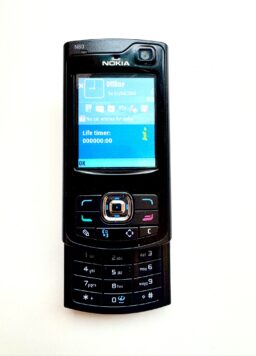
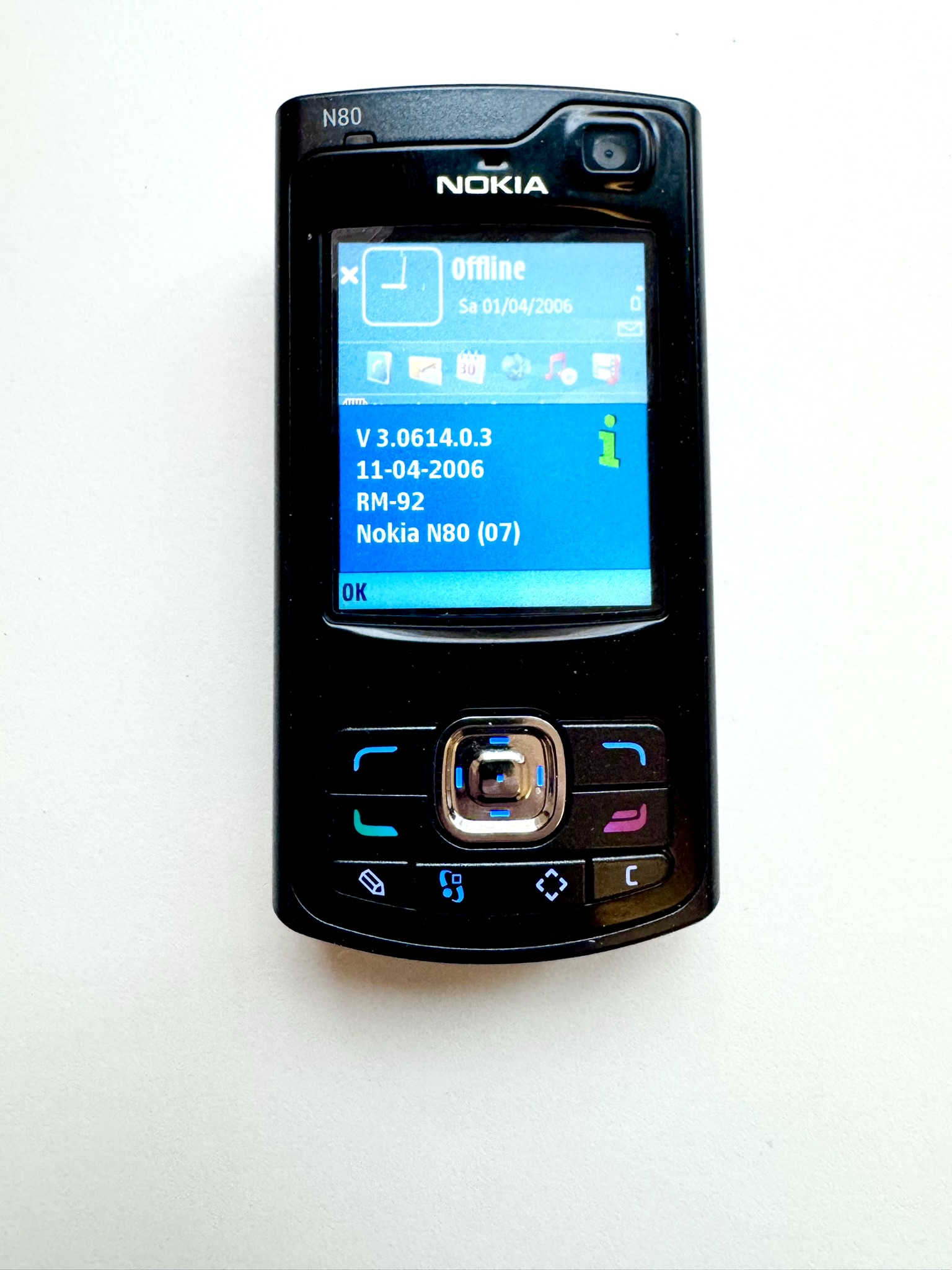
Nokia N80 Prototype S5.1: The birth of the World’s First UPnP Phone
Quick ViewThis unit represents the earliest surviving form of the world’s first UPnP-compatible phone, the Nokia N80, shown here in its S5.1 prototype stage long before the technology reached consumers. Built in Finland and marked with the legendary 004400 Nokia internal IMEI range, this device was part of Nokia’s secret push to bring home-network integration to mobile phones for the first time in history.
The internal label reveals everything expected from a genuine engineering sample: a masked FCC and IC set, the placeholder Xyy-n model code, and an unreleased product code known only to Nokia’s R&D teams. The bold PROTO S5.1 stamp indicates an early hardware validation cycle, a phase where engineers were still shaping the mechanics, RF behavior, and multimedia stack that would define the N80. A matching S5.1 barcode sticker on the side confirms that this device circulated between test teams, yet survived in untouched, mint condition – almost impossible for units used at this development depth.
UPnP was the N80’s signature innovation, a world-first feature allowing a mobile phone to discover and communicate with home media servers, TVs, and computers. But before the world ever saw this capability demonstrated on a stage, units like this one acted as the true testbeds. Early debug builds of Symbian OS 9.1 ran experimental networking stacks, Wi-Fi drivers, and service discovery modules. Engineers used devices like this to validate seamless connectivity, file sharing, remote playback, and the foundation of what would later become the connected-smartphone era.
The Finnish build origin makes the device even rarer. Only the earliest pilot-line N80 units came from Finland, assembled for hardware tuning, firmware experiments, and RF calibration. Most were disassembled, reworked to exhaustion, or destroyed after testing concluded. This one escaped untouched – a true anomaly.
With its dual proto identifiers preserved, its 004400 IMEI confirming deep internal lineage, and its role at the dawn of UPnP mobility, this N80 S5.1 prototype is not just a rare device. It is a technological milestone captured in physical form – the raw, unfiltered origin of the world’s first UPnP phone.
-


Nokia N93
Quick ViewNokia N93 is a smartphone from Nokia, part of the multimedia Nseries. It was introduced on 25 April 2006 and released in July 2006. It runs on Symbian OS v9.1 and the S60 3rd Edition interface. It was the most advanced camera phone from Nokia at the time of its release, and was particularly marketed for its camcorder, packed in its unique swivel design like its predecessor Nokia N90.
The N93 improved upon camera capabilities over the N90. The phone has a 3.2-megapixel camera, Carl Zeiss optics and 3x optical zoom (the first Nokia phone to have it) as well as a 30 fps 640×480 (VGA) MPEG-4 video recording capability.
It was succeeded by the Nokia N93i.
-


Samsung X820
Quick ViewSamsung SGH-X820, also known as Ultra Edition 6.9, is a mobile phone created by Samsung and announced in Q3 2006, as part of the Samsung Ultra Edition range.
Samsung marketed the device as “the world’s slimmest mobile phone”, and as a competitor to the Motorola SLVR L7. The X820 surpassed Samsung D830, released that same year, which Samsung previously marketed as “the world’s slimmest”.
The carrier-unlocked U.S. price on late July 2006 was $449.00
-


Sony Ericsson M600i
Quick ViewSony Ericsson M600 (sold as M600i model in some markets and originally labelled M608c in other markets) is a 3G smartphone based upon the UIQ 3 platform (which is built upon Symbian OS 9.1). It was announced on February 6, 2006 and is the first and only product of the M series of handsets from Sony Ericsson.The M600 is designed as a business tool and its features reflect this role. The M600 supports push email, document editing and PC synchronisation amongst other features. Notably the M600 does not have an integrated camera, which is a positive attribute for those working in environments where cameras are not permitted