Showing all 9 results
-
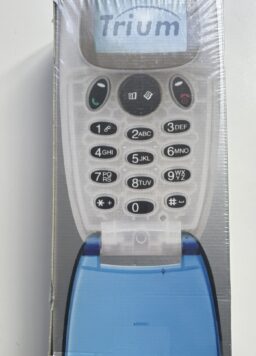
Mitsubishi Trium MT-250 Neptune Blue: Sealed Clamshell
Quick ViewThis unit is a sealed Trium MT-250 Neptune blue, preserved exactly as Mitsubishi shipped it during the final years of the Trium mobile era. Still wrapped in its original factory shrink, the box presents a classic early 2000s clamshell design with a translucent blue flip and a frosted keypad housing that defined the playful aesthetic of Trium handsets. The packaging shows the simple monochrome display with the Trium logo, underlining the minimalistic UI that characterized Mitsubishi’s compact GSM range.
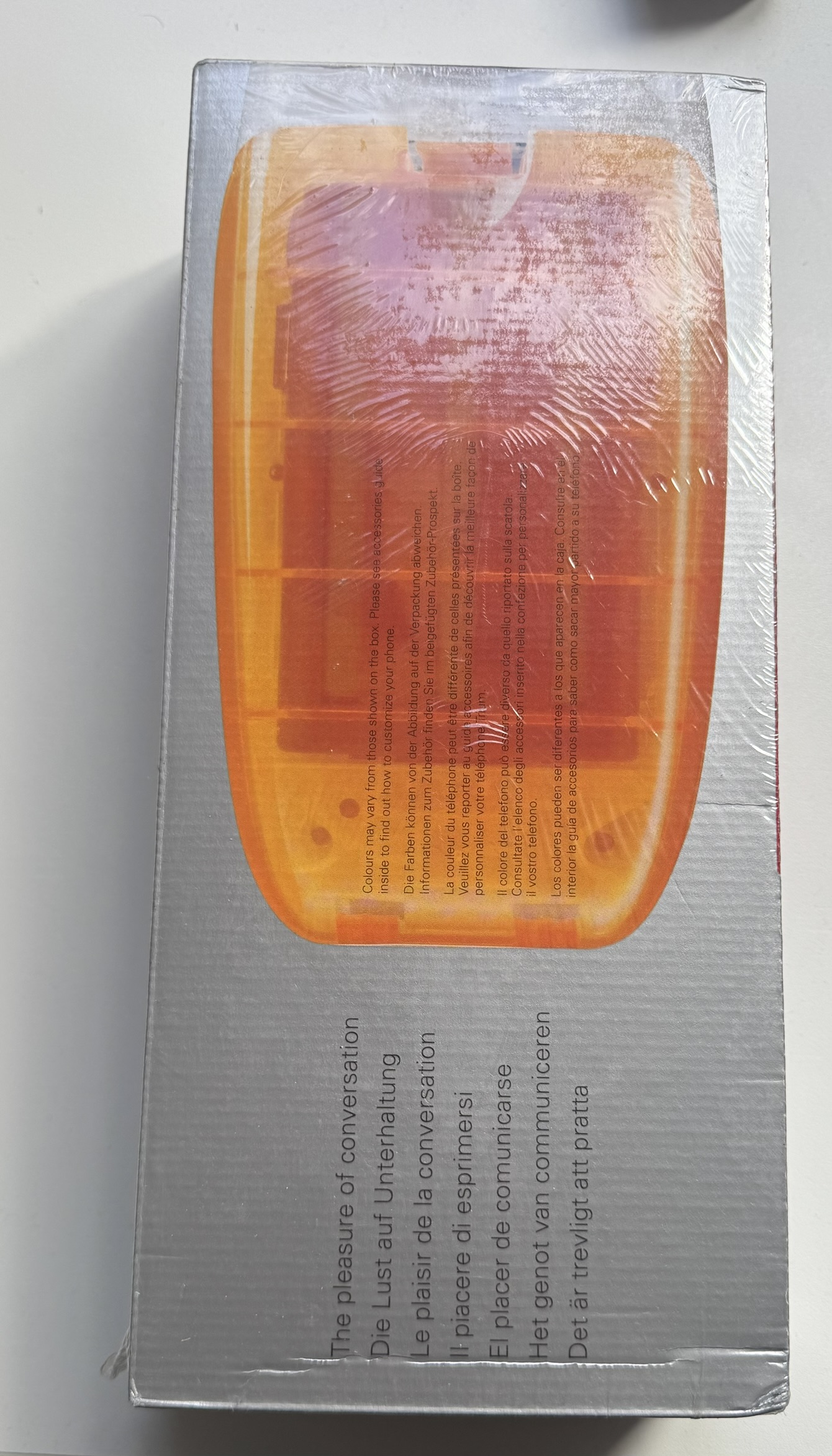
The side label confirms the exact variant: MT-250 Neptune blue with a Mitsubishi retail IMEI, CE0165 certification and an unbroken production batch code. Very little documentation exists for the MT-250 today, making this sealed example exceptionally rare. As Trium devices vanished from the market long before smartphones took over, complete unopened units almost never survived. This one stands as a pure, untouched snapshot of Mitsubishi’s design language, a lightweight clamshell aimed at style-focused users of its time. For collectors, it is a highly uncommon BNIB relic from a manufacturer whose mobile legacy has become increasingly scarce and desirable.
-


Nokia 5510
Quick ViewThe Nokia 5510 features a full QWERTY keyboard, and is notable for its digital music player, the company’s first mobile phone with music player capabilities.It has a 64 MB memory for storing audio files
-


Nokia 6500 Flip
Quick ViewNokia 6500 (NHM-7) – a genuine 2001 Chinese-market retail unit, produced at the Nokia Beijing factory (FAC 40) and certified under CMII ID 2001CJ0730. This variant carries the original Chinese/English firmware and the official ‘Telecom Network Access License’ hologram, confirming full approval for sale on China Mobile and China Unicom networks. With its early-2000s design, clean IMEI labeling and region-specific product code, this NHM-7 represents an authentic piece of Nokia’s expansion into the Asian GSM market. A rare and well-preserved example of a model seldom found outside China today.
-


Nokia THR850
Quick ViewThe new Nokia THR850 is the most advanced TETRA handportable on the market – Perfect for businesses who need to rapidly manage their mobile work force. Whatever the situation, your Nokia THR850 will keep you at the center of things. Simply press-to-talk and you can be connected to your team easily and instantly, just like with a two-way radio anywhere the counry. The advanced group communication features let you manage co-operation with other groups. Activate scanning for monitoring communications of essential groups. Make use of group priorities and dynamic groups for fast and flexible teamwork.
-
Nokia Unknown Model Prototype: CodeName Kabaka | Unreleased
Quick ViewNokia NPM-3NA “Caballa” – Unreleased 3G Prototype (2001)
The Nokia NPM-3NA is an extremely rare, unreleased prototype developed around 2001 during Nokia’s early work on Japan’s first 3G network, NTT DoCoMo’s FOMA. Built in very small internal batches, this device was used for radio testing, firmware evaluation and UI experiments, and was never certified or intended for public sale.
Running prototype firmware V55.40 (31-10-01) with the internal ? NMP signature and showing an unassigned IMEI (??????????????), the phone carries all hallmarks of an engineering sample. The internal hardware label NE8_06 / HW0250 suggests a development board related to NEC, a major DoCoMo technology partner in the early W-CDMA era. Its long extendable antenna and unique keypad design match the style of early FOMA trial devices, such as NEC’s X2001V.
With no public documentation, no final RM code, and no retail equivalent, the NPM-3NA stands as a rare glimpse into Nokia’s abandoned Japanese-market 3G program. A genuine collector-grade prototype, extremely uncommon and historically significant for anyone interested in unreleased Nokia hardware or the origins of modern 3G technology.
-
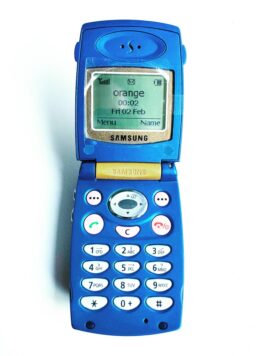
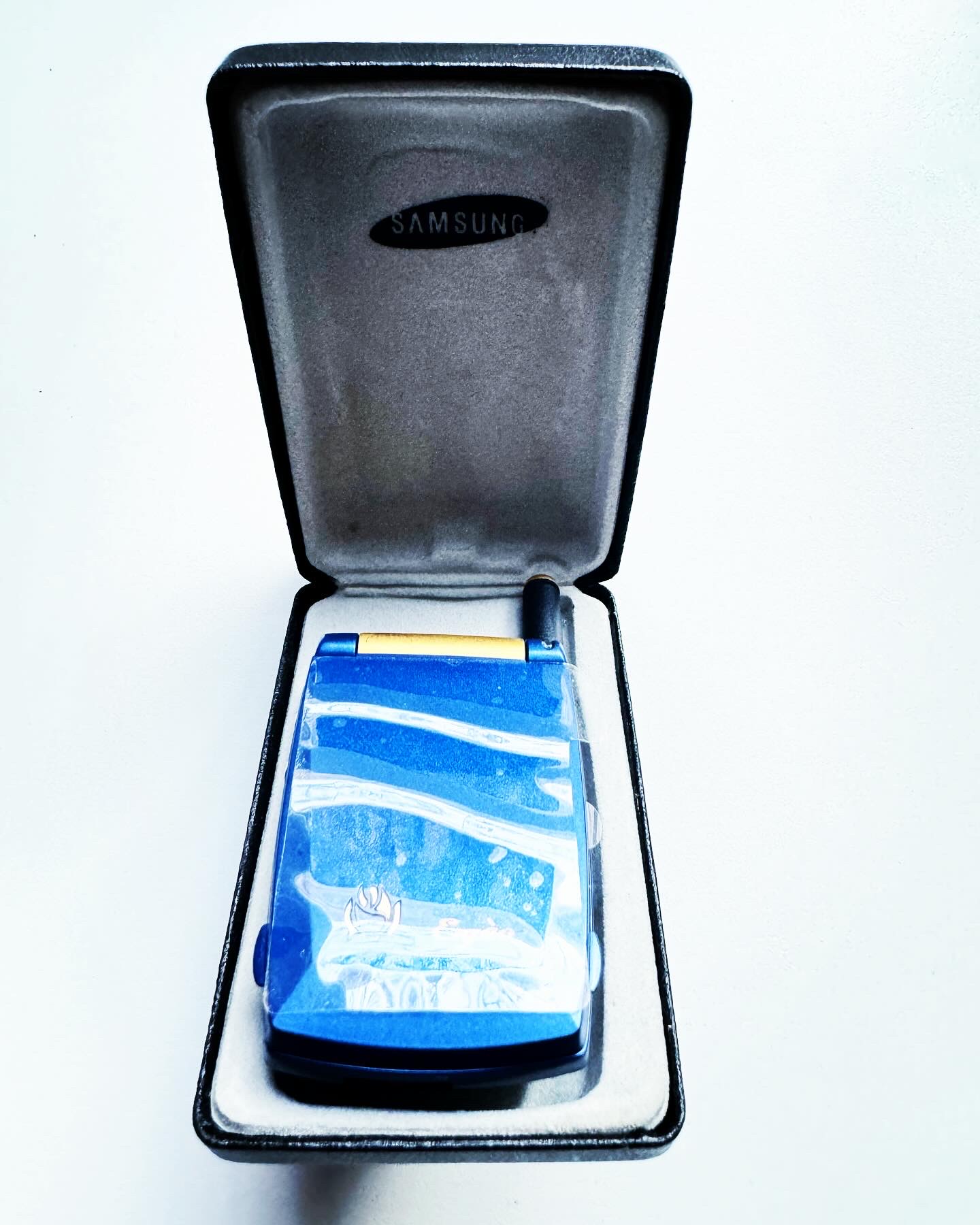
Samsung SGH-A408 “Egeo Edition”: Rare Custom Blue-Gold Variant
Quick ViewA rare Samsung SGH-A408 in the distinctive Egeo co-branded edition, featuring a striking blue-and-gold finish not seen in standard Samsung retail models. Manufactured in Korea, this version is part of a small-volume release used primarily for promotional partnerships and boutique-market customization, making it far harder to find than the regular A408.
The SGH-A408 was one of Samsung’s early compact flip phones, built during the transition period when Samsung began refining the sleek, stylized designs that later defined their SGH and X-series devices. The classic external antenna, metallic paint, and angular shell combine into a perfect late-90s / early-2000s Samsung aesthetic.
Your Egeo variant stands out through:
Gold hinge + gold logo unique to this edition
Branded Egeo flame insignia
Metallic deep-blue casing produced in limited quantities
Clean Korean manufacturing label indicating early production batch
Uncommon GSM variant (A408 GSMH)
These features make it one of the more unusual Samsung flip designs of its era – especially valuable for collectors of pre-2003 Samsung hardware and regional special editions.
-

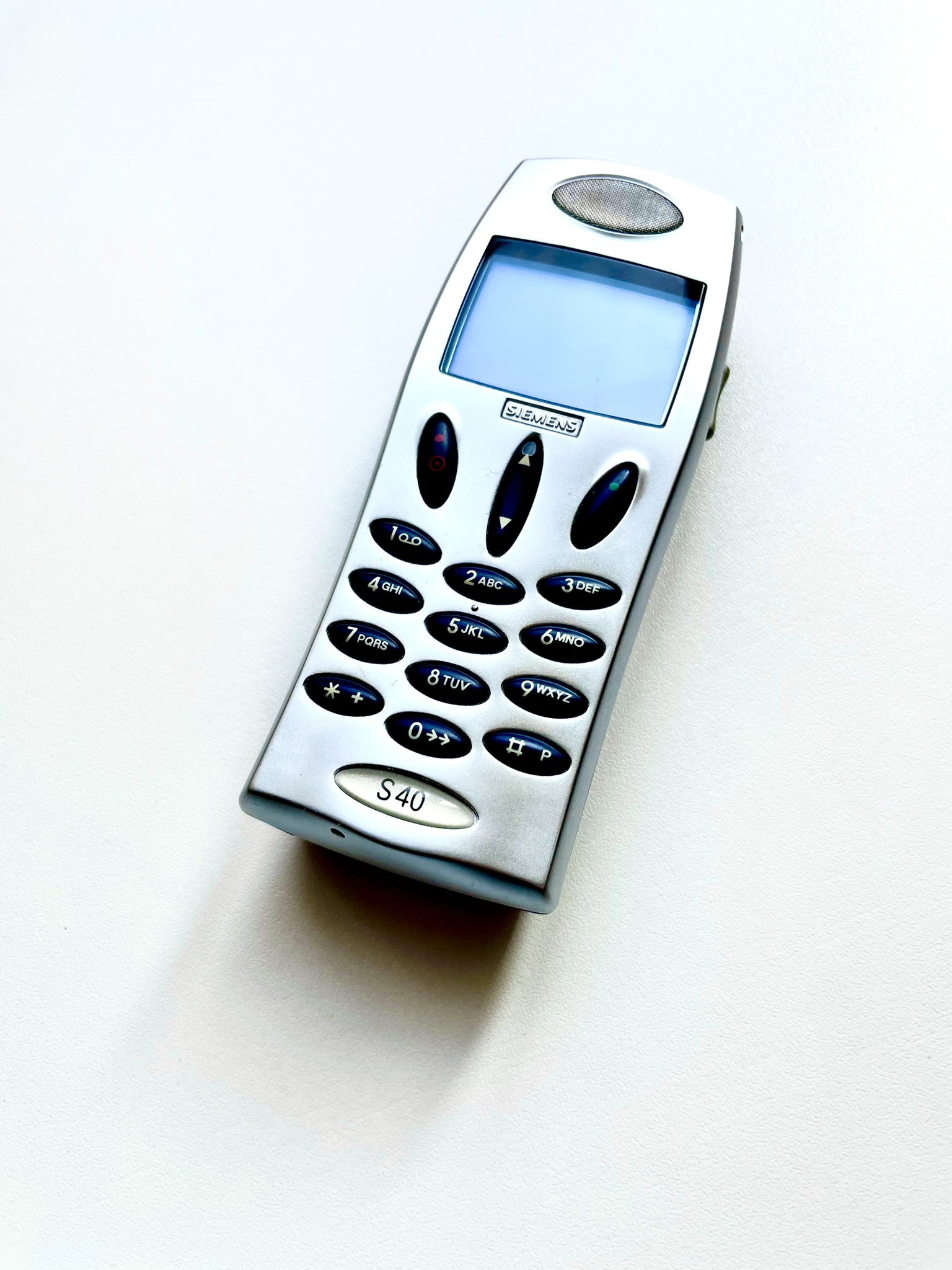
Siemens S40
Quick ViewThe Siemens S40 is a mobile phone. Originally developed as the Bosch 1886 in 2000, the phone was branded as the Siemens S40 after Siemens acquired the Bosch mobile phone division. The Siemens S40 is a tri-band mobile phone that operates on the GSM-900, GSM-1800, and GSM-1900 networks. Communication with a computer can be done either through the infrared port (IrDA) on the phone or a USB or serial port data cable. Its more distinctive features include the voice memo recorder, the mute feature for conversations, the ability to record phone conversations, and the ringtone composer (a useful alternative for those unsatisfied with the 47 monophonic ringtones).
In 2005, the phone made it onto CNET’s list of ten lowest-radiation cell phones, at #10, with a SAR (specific absorption rate) of 0.33.
The phone also supports WAP 1.1, SMS, HSCSD, and T9 predictive text input.
The S40 includes a 104×64 pixel monochrome liquid-crystal display with a blue backlight, an internal antenna, and rubbery buttons to prevent accidental dialing.
-


Siemens SL42
Quick ViewThe SL42 was cost reduced variant of the Siemens SL45.
It shipped with a Siemens branded 16MB Hitachi MultiMediaCard which had a holder that slide into the side of the phone.
The phone also lacked headphones and a sync cradle which were included with the SL45.
Other features included a digital voice recorder, WAP browser, address book and currency converter.
-


Sony Ericsson T68i
Quick ViewThe Ericsson T68m (often called simply T68) was a candy-bar style mobile phone by Ericsson Mobile Communications. Launched in time for the 2001 Christmas season, the T68 was the first Ericsson mobile phone to have a colour screen, a passive LCD-STN with a resolution of 101×80 and 256 colours. Despite its diminute size (3.94×1.89×0.79 in or 100x48x20 mm, 2.96 oz or 84 g), it was one of the most feature-rich mobile phones at the time, with Bluetooth, IrDA port, GPRS 3+1, tri-band compatibility (900 MHz, 1800 MHz and 1900 MHz), SMS with T9 (predictive text), EMS, WAP, and customizable monophonic ring tones. A simple bitmap image editor was provided, allowing the creation of monochrome pictures by guiding a cursor around the canvas and setting or unsetting individual pixels (several ‘brush’ sizes were selectable to make this easier). These images could be set as the phone’s background image in standby mode, and sent to owners of EMS-compliant phones. With EMS soon to be succeeded by the superior MMS, few owners made much use of this feature. At its release, the phone cost around &eur;o; 500, £299 in the UK, in either two-tone grey or all-gold.