Showing all 12 results
-


Alcatel One Touch Com
Quick ViewThe year is 1997. Nokia has just brought out the “Matrix cell phone” 8110, the Communicator is said to be another 3 years away. At Siemens you get either the S6 cooking spoon or the S10 with a three-color display. Ericsson has nothing to do with Sony yet, and the GF768 had to – and could – live with a single-line display. Until then, Alcatel was best known for the super cheap One Touch Easy series, but is now launching the One Touch Com. Alternatively, you can also order it from Sharp in the form of the identical MC-G1.
-


-


Kyocera DS-320
Quick ViewThe concept of mobile phones equipped with camera functions is not uncommon today. However, in the 90s of the last era, it is still a very incredible thing. At that time, the pager boom in China had just passed, and mobile phones were still in the ascendant. Fresh stuff, who would have thought of stuffing a small lens into such a small and exquisite body? Japan’s Kyocera first thought of this. In 1997, Kyocera launched a brand-new Datascope series, including DS-110 and DS-320 mobile phones. Monochrome LCD screens seem unremarkable, but, Also launched with them is a very eye-catching accessory-VS-110.
This accessory is driven by 2 AA batteries, can rotate 210 degrees, and can be movedIt can also be used as a standalone digital camera for video calls on the Internet. It is the world’s first mobile phone equipped with a camera and supports video calls. Although the practicality is very low, it is the first step taken by mobile phone manufacturers. From 1997 to 1999, Kyocera conducted two years of research and development on the basis of this mobile phone. In May 1999 The VP-210 is officially launched, which integrates the camera on the top of the phone, is equipped with a 110,000-pixel front lens and a 2-inch TFT color screen. It can not only make video calls, but also take 20 photos and share them via email. The first camera phone in the true sense.
-


Motorola StarTAC 85: The Black Heritage BNIB
Quick ViewThe Motorola StarTAC 85 is one of the most refined and well balanced GSM variants of the legendary StarTAC family, the first true clamshell mobile phones ever produced. Introduced in the late 1990s, the StarTAC 85 improved on earlier versions with updated internal circuitry, stronger radio performance, reinforced hinge tolerances, and better durability, while preserving the compact flip design that made the StarTAC line a global icon.
This unit is BNIB and comes as a complete full box set. That is an extremely rare condition for any StarTAC model. Most StarTAC 85 units were opened and used heavily, which over time led to worn housings, loose hinges, cracked antennas, and missing accessories. A full retail package with original box, inserts, charger, accessories and documentation, in unused or near unused state, places this device in the very top collector category. Fully boxed StarTAC 85 sets are believed to represent well under a few percent of all surviving devices.
Within the StarTAC GSM lineup, the 85 sits between the early 70 series and the later 130 models. It keeps the early generation proportions and clean design that collectors like, but benefits from mid cycle engineering improvements that make it more reliable for long term use. These refinements include improved grounding on the main board, more stable GSM 900 and 1800 radio stages, reinforced hinge stops, updated keypad dome sheets for more consistent feedback, and stronger internal plastics around key stress points. Many technicians consider the 85 one of the most robust early StarTAC variants.
The StarTAC family itself reshaped the mobile industry. Evolving from the earlier MicroTAC series, the StarTAC introduced the fully folding clamshell format and made compact, pocket friendly phones a reality for a wide audience. More than 60 million StarTAC units were sold worldwide, and in 2005 PC World listed the StarTAC as one of the greatest gadgets of the past 50 years. The StarTAC 85 carries this heritage with its minimalist black housing, slim antenna, clear monochrome display, compact footprint and precise hinge motion.
For collectors, a BNIB Motorola StarTAC 85 is one of the most desirable ways to own a piece of this history. It preserves not only the device, but also the full retail experience from the late 1990s, exactly as it would have been received by a first owner at that time. The combination of complete box, unused or near unused condition, and the technically refined 85 hardware makes this example a true boxed black heritage piece in the StarTAC line.
This StarTAC 85 – The Boxed Black Heritage stands as a museum grade artifact from the golden era of Motorola engineering. It is one of the finest surviving examples of the most influential flip phone design ever created and a centerpiece for any serious mobile phone collection.
-


Nokia 8110 Michael Schumacher Limited Edition No.0296 – The Impossible-to-Find Edition
Quick ViewThe Nokia 8110 Michael Schumacher Limited Edition No.0296 is one of the most remarkable collectible mobile phones ever released – and this specific unit stands out even within that ultra-rare group. Produced in a strictly limited run of 1,997 pieces worldwide, this device carries the official individual number 0296, matching the original Talkline-issued authenticity certificate, signed in print by Michael Schumacher himself. Every detail confirms its legitimacy as part of the official Michael Schumacher Collection, licensed by PPM.
This particular device remains in full-box condition, a rarity in its own right. The package includes the complete original set: the official certificate with matching number, original box and inserts, accessories, and the pristine handset finished in the iconic Schumacher red. The front fascia features Michael’s portrait subtly integrated into the sliding cover, accompanied by his stylized signature. The back includes the factory-applied Schumacher Collection sticker, with the same official sticker also present on the box and on the label inside the phone, ensuring absolute consistency and authenticity across all components.
As part of the broader Michael Schumacher mobile series, Nokia also released a Schumacher Edition Nokia 2110, a similarly themed model from the same era. It is an important companion piece to the 8110, and while highly sought after, it is not yet present in the collection, making the 8110 even more of a standout centerpiece until its counterpart is added.
Beyond the collectible value, the phone itself is an icon of mobile history: the Nokia 8110 was the first high-end slider of the Nokia 8000 series, the earliest “banana phone,” and a technological status symbol of the late 90s. Its curved silhouette, sliding mechanism that answers calls, and monochrome graphic LCD defined the era. The improved 8110i later introduced Smart Messaging – making this line the origin point for many modern phone features. The 8110 also achieved pop-culture immortality when a modified version appeared in The Matrix.
Combined with the Schumacher branding, this edition transforms the classic 8110 into something far more significant: a celebration of a Formula 1 legend at the height of his career. Owning unit 0296 means holding a true numbered artifact of motorsport history – a device tied directly to the most dominant driver of the era.
This is not just a limited edition phone. It is a preserved, authenticated piece of racing heritage, paired with one of the most iconic Nokia designs ever created.
-


Nokia 8110i
Quick ViewNokia 8110 is a mobile phone released in 1996. It was announced on September 9, 1996 as the first of Nokia’s high-end 8000 series of phones.Its distinctive styling was the first example of a ‘slider’ form factor. A sliding cover protected the keypad when being carried in the pocket and extended downwards in use, bringing the microphone closer to the mouth.The action of opening the cover also answered an incoming call. The prominent curvature of the case, particularly when open, earned it the nickname “banana phone”. It was also the first Nokia phone with monochrome graphic LCD. The phone was designed for the business market and was one of the smallest and lightest (152 grams) phones on the market, but still had better battery life than its predecessor Nokia 2110. The improved 8110i model, announced in March 1997, was the first phone with the SSMS (Smart SMS) engine.The handsets could be updated OTA (Over The Air) with an intelligent menu structure, which allowed simple information input, input which was sent through a simple structured text message to an MT receiver. This station could interpret information and a structured text message back to the handset. Ring tone receiving by SMS was also part of the smart messaging protocol, so 8110i was also the first mobile phone to support it. Nokia later stopped marketing Smart messaging and concentrated on the upcoming WAP standard, but has not dropped smart messaging support from later phones. Both models were succeeded by Nokia 8810 in 1998. The phone was famously featured in the science fiction action film The Matrix (1999), for which it was modified featuring spring-loaded mechanism (this later appeared on the Nokia 7110).
-


Nokia 8148i
Quick ViewNokia 8148i is a variant of Nokia 8110 and it only works on GSM 1800.
Nokia 8110 is a mobile phone released in 1996. It was announced on September 9, 1996 as the first of Nokia’s high-end 8000 series of phones.Its distinctive styling was the first example of a ‘slider’ form factor. A sliding cover protected the keypad when being carried in the pocket and extended downwards in use, bringing the microphone closer to the mouth.The action of opening the cover also answered an incoming call. The prominent curvature of the case, particularly when open, earned it the nickname “banana phone”. It was also the first Nokia phone with monochrome graphic LCD. The phone was designed for the business market and was one of the smallest and lightest (152 grams) phones on the market, but still had better battery life than its predecessor Nokia 2110. The improved 8110i model, announced in March 1997, was the first phone with the SSMS (Smart SMS) engine.The handsets could be updated OTA (Over The Air) with an intelligent menu structure, which allowed simple information input, input which was sent through a simple structured text message to an MT receiver. This station could interpret information and a structured text message back to the handset. Ring tone receiving by SMS was also part of the smart messaging protocol, so 8110i was also the first mobile phone to support it. Nokia later stopped marketing Smart messaging and concentrated on the upcoming WAP standard, but has not dropped smart messaging support from later phones. Both models were succeeded by Nokia 8810 in 1998. The phone was famously featured in the science fiction action film The Matrix (1999), for which it was modified featuring spring-loaded mechanism (this later appeared on the Nokia 7110).
-
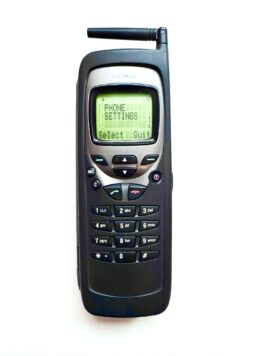

Nokia 9000iL Communicator: The Iconic Mobile Office
Quick ViewThe Nokia 9000iL Communicator is the rarest and most advanced version of the first-generation Communicator family. Released in 1997-1998 for the U.S. market only, it delivered true mobile computing capabilities years before any competitor. At a time when phones could barely handle SMS, the 9000iL could send email, browse early web pages, access corporate servers, send/receive faxes, and run productivity tools – all while doubling as a fully functional GSM phone.
Powered by an Intel 486-class processor and running the GEOS-based Nokia Communicator OS, the 9000iL was essentially a miniature laptop disguised as a phone. Its iconic clamshell design with an external phone interface and a wide internal LCD display made it instantly recognizable – and a status symbol for professionals who needed real mobile data in the late 90s.
Your unit, with its pristine RAB-4N label, Made in Finland stamp, and correct IMEI layout, is exactly the type of 9000iL that U.S. carriers imported in controlled quantities. It is a foundational piece of mobile history and a must-have for any serious Nokia collector.
-


Siemens S10
Quick ViewThe Siemens S10 was the world’s first phone with a colour screen. It was a high end business phone with a number of a advanced features. However, the phone was not up to rival products from Nokia and Ericsson and the colour screen did not make it any more usable.
-


Sony CMDX 1000
Quick ViewPhone CMD-X1000 by Sony is made in the classic shape. Phone dimensions: width – 45 millimeters, height – 150 millimeters, thickness – 33 millimeters. Weight – 235 grams. Capacity of Li-Ion battery is 1350 mA?h, this is approximately 70 hours of standby time and 10 hours of talk time.


