

">

Showing 13–24 of 106 results
-


Motorola F3
Quick View💎 Rarity Index: C (Common)
⭐ WOW Factor: The first mobile phone to use electronic paper in its screen
👁 Evaluation in my collection: BNIB – 10/10
⏱ Life timer: 0m | 📦 Boxed: YES
📅 Release Year: 2006 | 💰 Release Price: ~20 €
📊 Units Sold: ~6M
📰 Why this phone matters: The F3 (frequently known as the Motofone) was a GSM phone available in two band variants, and was released on 28 November 2006.
The Motofone F3 was designed to appeal to the low-end market and developing countries, and was thus less functional, but also less expensive than most phones. Motorola made it appealing to developing markets and people with reading and visual difficulties by using only simple symbols and using speech synthesis to identify tasks in the menu.
The F3 was the first mobile phone to use electronic paper in its screen. Motorola used the term ClearVision to describe the new display, which was manufactured using E Ink’s electrophoretic imaging film. The electronic paper main display allowed for the phone’s thinness (no glass), longer battery life, and outdoor viewability (paper-like reflectivity). It had a backlight for the keypad and a slit that projects the backlight onto the screen so the display can be seen in darkness.The characteristics of the display were fairly restrictive. The text display contained only two lines of six characters each, making the use of text messaging (SMS) and data services less practical than on standard LCD displays. The display used a fixed ‘digital clock’ style font, with no functionality for changing between upper case and lower case text. All SMSs sent by the F3 were received entirely in lower case, and each character of any SMS received by the F3 is displayed in whichever case made the most sense using the font. Also, the non-alphabetic characters were severely limited due to this display, as the phone could only provide support for the following characters:
Comma (,) (periods . in incoming text messages are displayed as commas)
Hyphen (-)
Question mark (?)
At-sign (@)
Asterisk (*)
(+), to write this character, hold down the 0 key
No other non-alphanumeric characters could be entered, and on receiving an SMS any non-alphabetic character not listed above was displayed as a hyphen.Although the display could be restrictive when it came to text applications, the display was very energy efficient and conducive to extremely long battery life.
📝 Reviews when released: Trusted Reviews 🔗
-


Motorola Flipout
Quick View💎 Rarity Index: C (Common)
👁 Evaluation in my collection: Great – 9/10
⏱ Life timer: N/A | 📦 Boxed: NO
📅 Release Year: 2010 | 💰 Release Price: ~100 €
📊 Units Sold: ~700k
📰 Why this phone matters: Its square-shaped body has two parts that rotate near the bottom-right corner to reveal a five-row QWERTY keyboard below the screen. It has an accelerometer and includes a web browser with Adobe Flash Lite 3.0.The Flipout replaces the bigger Backflip.📝 Reviews when released: Mobile Review 🔗
-


Motorola Gleam
Quick View💎 Rarity Index: C (Common)
👁 Evaluation in my collection: Great – 9/10
⏱ Life timer: N/A | 📦 Boxed: YES
📅 Release Year: 2011 | 💰 Release Price: 99 €
📊 Units Sold: ~1M
📰 Why this phone matters: For the clamshell type factor and for the similar design, the terminal is considered the heir of the Motorola RAZR V3 .
On the upper part, under the lens of the 2 megapixel camera , there is a notification LED that informs about the time and about any incoming calls or messages; has Bluetooth 2.1 + EDR technology.
It is placed on the market in the three variants of gray ( gray ), thistle (thistle, a very light variety of violet ) and lacquer red ( lacquered red )📝 Reviews when released: N/A 💔
-


Motorola VE66
Quick View💎 Rarity Index: B (Uncommon)
👁 Evaluation in my collection: BNIB – 10/10
⏱ Life timer: 0m | 📦 Boxed: YES
📅 Release Year: 2008 | 💰 Release Price: ~250 €
📊 Units Sold: ~1M
📰 Why this phone matters: VE 66 had the MotoMagx which is a Linux kernel-based mobile operating system developed and launched in 2007 by Motorola to run on their mid-to-high-end mobile phones. The system is based on MontaVista’s Mobilinux. Originally intended for the 60% of their upcoming devices, it was soon dropped in favor of Android and Windows Mobile operating systems.📝 Reviews when released: N/A 💔
-


NEC e616v
Quick View💎 Rarity Index: C (Common)
👁 Evaluation in my collection: Great – 9/10
⏱ Life timer: N/A | 📦 Boxed: NO
📅 Release Year: 2003 | 💰 Release Price: N/A
📊 Units Sold: ~2M
📰 Why this phone matters: N/A📝 Reviews when released: N/A 💔
-
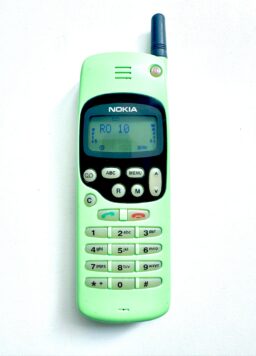

Nokia 1610
Quick View💎 Rarity Index: C (Common)
👁 Evaluation in my collection: Great – 9/10
⏱ Life timer: N/A | 📦 Boxed: YES
📅 Release Year: 1996 | 💰 Release Price: N/A
📊 Units Sold: ~10M
📰 Why this phone matters: Nokia 1610 is a mobile phone model manufactured by Nokia. It complemented the Nokia 2110 business model, but had significantly fewer features. It was introduced in April 1996 and released in May and became highly popular at the time.
The phone had a monochromatic display which could show two rows of text at a time. The operating manual did not mention a possibility to send text messages, but at least units sold from 1996 and onwards included the function. The SMS capable version was called 1610 Plus. The phone used an external rigid antenna, but had a groove on the inside of the battery to accommodate a pull-out type antenna. The 1610 used a credit card size SIM-card, and was powered by a NiMH type battery with a capacity of 600 mAh.📝 Reviews when released: N/A 💔
-


Nokia 2010
Quick View💎 Rarity Index: B (Uncommon)
👁 Evaluation in my collection: Great – 9.5/10
⏱ Life timer: N/A | 📦 Boxed: YES
📅 Release Year: 1994 | 💰 Release Price: N/A
📊 Units Sold: ~200k
📰 Why this phone matters: The Nokia 2010 is a mobile phone that was announced by Finnish phone manufacturer Nokia in January 1994.
According to the late Matti Makkonen, a manager of Nokia Mobile Phones at the time, Nokia 2010 was the first mobile phone to enable writing messages easily.
Other features include lists of 10 dialled calls, 10 received calls and 10 missed calls.
The phone has a monochromatic display that can show two rows of text at a time, which are surrounded by symbols for dedicated functions – battery status and reception level on either side; SMS message notification, keypad lock, et al. at the top. The handset has an antenna slot that supports either an external rigid antenna, or a pull-out type antenna (more common). The 2010 used a full-size (1FF) sim-card.
Nokia 2010 was the more affordable version in the 2xxx series than the business-oriented Nokia 2110, both of which were released in 1994.
In terms of design, the 2010 stayed truer to its predecessor model of Nokia 1011 than the 2110.📝 Reviews when released: N/A 💔
-


Nokia 3100
Quick View💎 Rarity Index: D (Very Common)
👁 Evaluation in my collection: Great – 9.8/10
🕵 Nokia Codename: Maxine
⏱ Life timer: 270h | 📦 Boxed: NO
📅 Release Year: 2003 | 💰 Release Price: 50 $
📊 Units Sold: ~15M
📰 Why this phone matters: The Nokia 3100 is a triband-GSM mobile phone announced on 17 June 2003 as an entry-level phone from Nokia and released in September 2003, designed primarily for the newer generation of marketing audience.
The Nokia 3100 was developed from the Nokia 6100 as a successor to the Nokia 3510. The phone was Nokia’s first in the youth-oriented 3000-series to be equipped with a 128×128 pixel passive colour display (4096 colors/12-bit), and included Java MIDP 1.0, XHTML and WAP browser, GPRS, Pop-Port connectivity and Lithium-ion battery. It is also capable of playing polyphonic MIDI files, which can be used as ringtones.
It is compact in size and lightweight, and also features special lighting effects.📝 Reviews when released: N/A 💔
-


Nokia 3210 – The Youth Icon
Quick View💎 Rarity Index: D (Very Common)
👁 Evaluation in my collection: As New – 10/10
⏱ Life timer: 5m | 📦 Boxed: YES
📅 Release Year: 1999 | 💰 Release Price: ~150 £
📊 Units Sold: ~160M
📰 Why this phone matters: The Nokia 3210 is one of the most important mobile phones ever made, a device that redefined the industry and introduced a new era of mobile culture. Released in 1999, it was the first Nokia phone designed specifically for young users, with a focus on style, entertainment, and ease of use. It introduced T9 predictive text, internal antenna design, customizable Xpress-On covers, and three built-in games that helped shape mobile entertainment.The 3210 is historically important as the first widely produced Nokia with a true internal antenna, a major step that defined the design of every Nokia released afterward. This engineering milestone allowed Nokia to eliminate the external antenna stub while maintaining strong GSM reception, setting a new standard for mobile phone design across the entire industry.
This BNIB unit represents the 3210 at its absolute best. With its lightweight form, strong reception, long battery life, and classic Nokia durability, the 3210 became a global phenomenon, selling around 160 million units worldwide. Its internal antenna was a major engineering achievement, eliminating the need for external protruding parts and contributing to its clean, modern look.
Customizable covers made the 3210 a fashion statement. The included green Xpress-On cover is a less common variant that adds even more collector value to this unit. Because the 3210 was heavily used by millions of people for years, finding a new-in-box example is extremely rare, and such units are now considered valuable pieces of mobile history.
The Nokia 3210 remains a cultural icon and a milestone in Nokia’s development. This BNIB example is a perfect representation of one of the most influential handsets ever produced and a standout addition to any serious mobile phone collection.
📝 Reviews when released: N/A 💔
-


Nokia 3230
Quick View💎 Rarity Index: C (Common)
👁 Evaluation in my collection: Great – 9.5/10
⏱ Life timer: N/A | 📦 Boxed: NO
📅 Release Year: 2005 | 💰 Release Price: 350 €
📊 Units Sold: ~5M
📰 Why this phone matters: The Nokia 3230 is a Symbian Series 60 smartphone announced on November 2, 2004. It was billed as the first Series 60 phone aimed at the mass-market rather than the higher-end Series 60 devices with a relatively low cost of 350 eur;os when released in Q1 2005.This phone was designed as a replacement for two previous youth-oriented Nokia phones – the Nokia 3660 Series 60 smartphone and the Nokia 3220 feature phone. No variant of this phone was released for the United States market.It runs on Series 60 2nd Edition Feature Pack 1 (Version 2.1), based on Symbian OS 7.0s. It features several games (including multiplayer Bluetooth games), a 1.23-megapixel camera, Nokia Lifeblog, a 32 MB RS-MMC to store extra images and applications, Push to Talk, a 176×208 pixel 65,536-colour screen, multimedia messaging, and RealPlayer.
The Nokia 3230 is one of the first with Push to Talk over Cellular (PoC), a walkie-talkie style method of communicating, and also Visual Radio, which enhances a normal radio receiver with extra info about artists and songs delivered over GPRS.
For data transfer, the phone can use EDGE to upload up to 35.2 kbit/s and download up to 178.6 kbit/s, and is a GPRS multislot class 10, up to 80 kbit/s.
Known issues
It has been frequently reported that fine dust get into the space between the LCD screen and the transparent plastic cover. The dust can be manually removed by opening the plastic case.In common with many phones of this type, the battery life is not as much as you would expect on older models of phones. Less than 2 days is typical whereas older ‘mono screen’ phones can often manage a week between recharging.
Users also reported that before the call ringtone sound, the 3230 would give a loud “beep” sound, with no way to turn it off or control its volume. The device would beep even on silent mode. This issue was most common in the early models of the phone.
Other users have reported slow response times for the camera, sudden screen blackouts and random reboots.
📝 Reviews when released: Trusted Review 🔗
-


Nokia 3300a
Quick View💎 Rarity Index: B (Uncommon)
👁 Evaluation in my collection: Brand New – 10/10
🕵 Nokia Codename: Hitchiker
⏱ Life timer: 0m | 📦 Boxed: NO
📅 Release Year: 2003 | 💰 Release Price: ~330 $
📊 Units Sold: ~2M
📰 Why this phone matters: The succesor of 5510, it supports MP3 and AAC audio and comes with an FM radio, and it can also be used as a digital voice recorder. Included in the standard package is a 64MB MMC memory card for storing data. GPRS data is supported, the display is a 128 x 128 pixel CSTN pane📝 Reviews when released: Mobile Review 🔗
-


Nokia 3310 DS
Quick View💎 Rarity Index: D (Very Common)
👁 Evaluation in my collection: Great – 9/10
⏱ Life timer: N/A | 📦 Boxed: YES
📅 Release Year: 2017 | 💰 Release Price: ~50 €
📊 Units Sold: ~12M
📰 Why this phone matters: The Nokia 3310 (2017) is a Nokia-branded feature phone developed by HMD Global. It was announced on 26 February 2017 at Mobile World Congress (MWC) 2017 in Barcelona, Spain, as a revival of the original Nokia 3310 that was produced from early 2000s. An improved model with 3G support was released on 29 October 2017. On 14 February 2017, it was reported that a modernised version of the 3310 would be unveiled at the 2017 Mobile World Congress in Barcelona by HMD Global Oy, a Finnish manufacturer with rights to market phones under the Nokia brand, with the price point of 59 eur;os. On 26 February 2017, the modernised version of the 3310 was relaunched at a price of &eur;o;49.The initial 3310 release only came with support for 2G networks, which led to criticism especially as a number of countries, including the United States,Australia and Singapore were in the process of phasing out their 2G networks; an improved variant of the phone with support for 3G networks was later announced by HMD, released on 29 October 2017.
📝 Reviews when released: PCMag 🔗