

">

Showing 13–24 of 38 results
-
Motorola iDEN NASCAR: Dale Earnhardt Jr. – Driver Number 8
Quick View💎 Rarity Index: A (Rare)
⭐ WOW Factor: Limited-edition printed shells were released in very small quantities through promotions tied to NASCAR sponsors
👁 Evaluation in my collection: Great – 9/10
⏱ Life timer: N/A | 📦 Boxed: YES
📅 Release Year: 2003 | 💰 Release Price: N/A
📊 Units Sold: ~50k
📰 Why this phone matters: “This series brings together a rare and visually striking set of Motorola iDEN NASCAR edition phones, each one finished in the exact colors and markings of some of the most iconic drivers of the era. The front housings carry the bold driver numbers and printed signatures that fans once saw streaking around American tracks: the famous 8 used by Dale Earnhardt Jr.Other major NASCAR stars tied to number-based fan merchandising from the same period include Jimmie Johnson (48), Matt Kenseth (17), Kevin Harvick (29), Mark Martin (6), Rusty Wallace (2), Michael Waltrip (15), and others whose liveries became instantly recognizable in early 2000s motorsport culture. Mentioning them highlights the broader context in which these promotional Motorola phones were released.
Instead of simple decals, these editions feature full factory-printed graphics applied directly to the flip shell, giving them a premium, high-gloss look that stands far above ordinary Motorola releases. Built on Motorola’s rugged iDEN flip-phone platform, these devices were originally tied to the push-to-talk culture that defined the Nextel era. With their tall antennas, external displays, loud front speakers, and the classic M-logo medallions, they capture the unmistakable flavor of early 2000s telecom design.
Today, iDEN handsets with licensed NASCAR artwork are almost never found in mint or BNIB condition, making surviving units especially rare. Together, these themed phones stand as a vivid motorsport showcase, capturing the crossover between mobile technology and racing, and preserving a bold piece of American fan history that has long since disappeared from the mar
“
📝 Reviews when released: N/A 💔
-
Motorola iDEN NASCAR: Dale Jarrett – Driver Number 88
Quick View💎 Rarity Index: A (Rare)
⭐ WOW Factor: Limited-edition printed shells were released in very small quantities through promotions tied to NASCAR sponsors
👁 Evaluation in my collection: Great – 9/10
⏱ Life timer: N/A | 📦 Boxed: YES
📅 Release Year: 2003 | 💰 Release Price: N/A
📊 Units Sold: ~50k
📰 Why this phone matters: “This series brings together a rare and visually striking set of Motorola iDEN NASCAR edition phones, each one finished in the exact colors and markings of some of the most iconic drivers of the era. The front housings carry the bold driver numbers and printed signatures that fans once saw streaking around American tracks: 88 associated with Dale Jarrett and, in later seasons, Dale Earnhardt Jr. as well.Other major NASCAR stars tied to number-based fan merchandising from the same period include Jimmie Johnson (48), Matt Kenseth (17), Kevin Harvick (29), Mark Martin (6), Rusty Wallace (2), Michael Waltrip (15), and others whose liveries became instantly recognizable in early 2000s motorsport culture. Mentioning them highlights the broader context in which these promotional Motorola phones were released.
Instead of simple decals, these editions feature full factory-printed graphics applied directly to the flip shell, giving them a premium, high-gloss look that stands far above ordinary Motorola releases. Built on Motorola’s rugged iDEN flip-phone platform, these devices were originally tied to the push-to-talk culture that defined the Nextel era. With their tall antennas, external displays, loud front speakers, and the classic M-logo medallions, they capture the unmistakable flavor of early 2000s telecom design.
Today, iDEN handsets with licensed NASCAR artwork are almost never found in mint or BNIB condition, making surviving units especially rare. Together, these themed phones stand as a vivid motorsport showcase, capturing the crossover between mobile technology and racing, and preserving a bold piece of American fan history that has long since disappeared from the mar
“
📝 Reviews when released: N/A 💔
-
Motorola iDEN NASCAR: Driver Number Series
Quick View💎 Rarity Index: A (Rare)
⭐ WOW Factor: Limited-edition printed shells were released in very small quantities through promotions tied to NASCAR sponsors
👁 Evaluation in my collection: Great – 9/10
⏱ Life timer: N/A | 📦 Boxed: YES
📅 Release Year: 2003 | 💰 Release Price: N/A
📊 Units Sold: ~50k
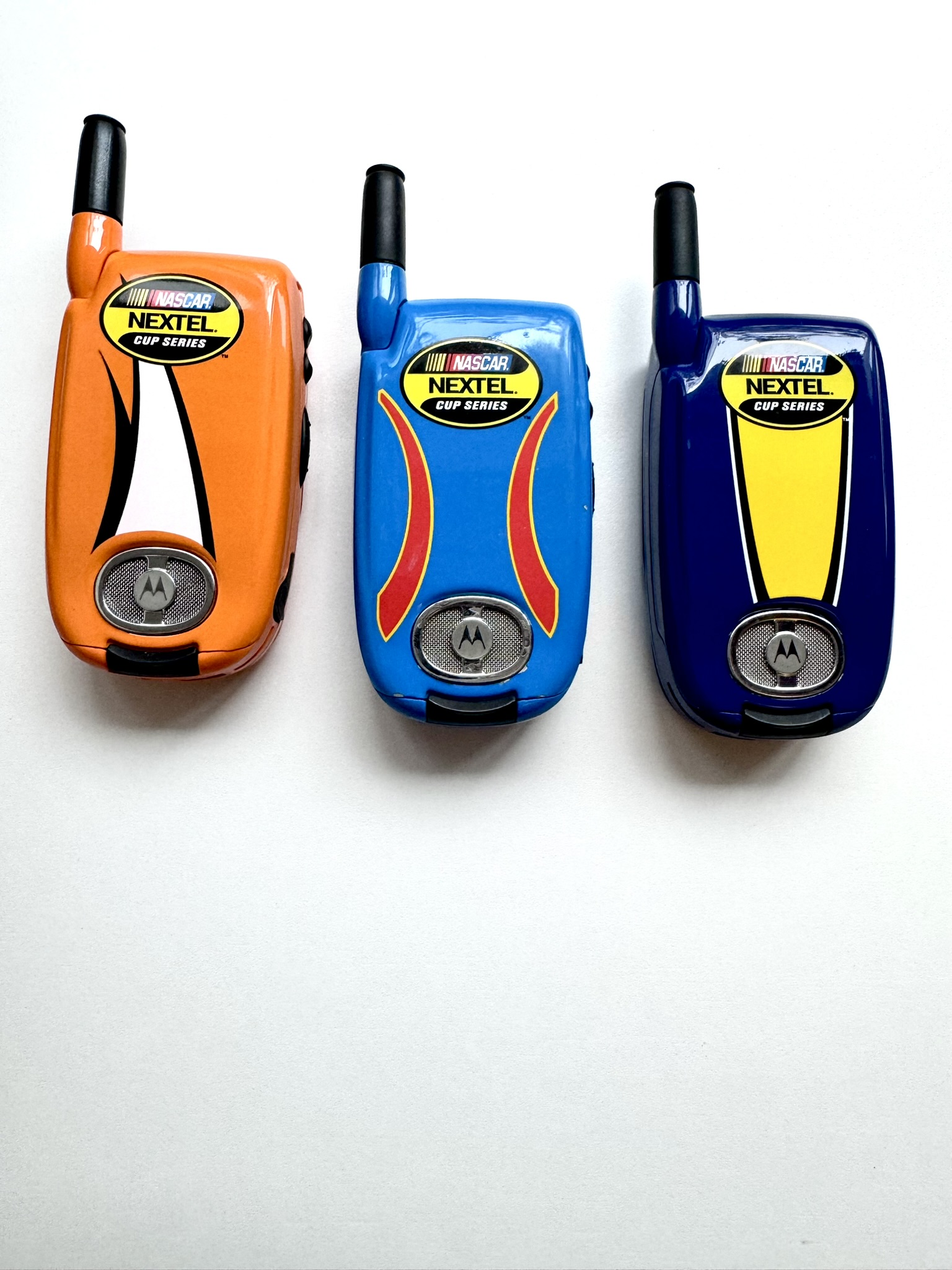
📰 Why this phone matters: This series brings together a rare and visually striking set of Motorola iDEN NASCAR edition phones, each one finished in the exact colors and markings of some of the most iconic drivers of the era. The front housings carry the bold driver numbers and printed signatures that fans once saw streaking around American tracks: 24 in blue and yellow for Jeff Gordon, 20 in bright orange and black for Tony Stewart, 97 in deep blue with yellow for Kurt Busch, along with the famous 8 used by Dale Earnhardt Jr. and 88 associated with Dale Jarrett and, in later seasons, Dale Earnhardt Jr. as well.Other major NASCAR stars tied to number-based fan merchandising from the same period include Jimmie Johnson (48), Matt Kenseth (17), Kevin Harvick (29), Mark Martin (6), Rusty Wallace (2), Michael Waltrip (15), and others whose liveries became instantly recognizable in early 2000s motorsport culture. Mentioning them highlights the broader context in which these promotional Motorola phones were released.
Instead of simple decals, these editions feature full factory-printed graphics applied directly to the flip shell, giving them a premium, high-gloss look that stands far above ordinary Motorola releases. Built on Motorola’s rugged iDEN flip-phone platform, these devices were originally tied to the push-to-talk culture that defined the Nextel era. With their tall antennas, external displays, loud front speakers, and the classic M-logo medallions, they capture the unmistakable flavor of early 2000s telecom design.
Today, iDEN handsets with licensed NASCAR artwork are almost never found in mint or BNIB condition, making surviving units especially rare. Together, these themed phones stand as a vivid motorsport showcase, capturing the crossover between mobile technology and racing, and preserving a bold piece of American fan history that has long since disappeared from the mar
📝 Reviews when released: N/A 💔
-
Motorola iDEN NASCAR: Jeff Gordon – Driver Number 24
Quick View💎 Rarity Index: A (Rare)
⭐ WOW Factor: Limited-edition printed shells were released in very small quantities through promotions tied to NASCAR sponsors
👁 Evaluation in my collection: Great – 9/10
⏱ Life timer: N/A | 📦 Boxed: YES
📅 Release Year: 2003 | 💰 Release Price: N/A
📊 Units Sold: ~50k
📰 Why this phone matters: “This series brings together a rare and visually striking set of Motorola iDEN NASCAR edition phones, each one finished in the exact colors and markings of some of the most iconic drivers of the era. The front housings carry the bold driver numbers and printed signatures that fans once saw streaking around American tracks: 24 in blue and yellow for Jeff Gordon.Other major NASCAR stars tied to number-based fan merchandising from the same period include Jimmie Johnson (48), Matt Kenseth (17), Kevin Harvick (29), Mark Martin (6), Rusty Wallace (2), Michael Waltrip (15), and others whose liveries became instantly recognizable in early 2000s motorsport culture. Mentioning them highlights the broader context in which these promotional Motorola phones were released.
Instead of simple decals, these editions feature full factory-printed graphics applied directly to the flip shell, giving them a premium, high-gloss look that stands far above ordinary Motorola releases. Built on Motorola’s rugged iDEN flip-phone platform, these devices were originally tied to the push-to-talk culture that defined the Nextel era. With their tall antennas, external displays, loud front speakers, and the classic M-logo medallions, they capture the unmistakable flavor of early 2000s telecom design.
Today, iDEN handsets with licensed NASCAR artwork are almost never found in mint or BNIB condition, making surviving units especially rare. Together, these themed phones stand as a vivid motorsport showcase, capturing the crossover between mobile technology and racing, and preserving a bold piece of American fan history that has long since disappeared from the mar
“
📝 Reviews when released: N/A 💔
-
Motorola iDEN NASCAR: Kurt Busch – Driver Number 97
Quick View💎 Rarity Index: A (Rare)
⭐ WOW Factor: Limited-edition printed shells were released in very small quantities through promotions tied to NASCAR sponsors
👁 Evaluation in my collection: Great – 9/10
⏱ Life timer: N/A | 📦 Boxed: YES
📅 Release Year: 2003 | 💰 Release Price: N/A
📊 Units Sold: ~50k
📰 Why this phone matters: “This series brings together a rare and visually striking set of Motorola iDEN NASCAR edition phones, each one finished in the exact colors and markings of some of the most iconic drivers of the era. The front housings carry the bold driver numbers and printed signatures that fans once saw streaking around American tracks: 97 in deep blue with yellow for Kurt BuschOther major NASCAR stars tied to number-based fan merchandising from the same period include Jimmie Johnson (48), Matt Kenseth (17), Kevin Harvick (29), Mark Martin (6), Rusty Wallace (2), Michael Waltrip (15), and others whose liveries became instantly recognizable in early 2000s motorsport culture. Mentioning them highlights the broader context in which these promotional Motorola phones were released.
Instead of simple decals, these editions feature full factory-printed graphics applied directly to the flip shell, giving them a premium, high-gloss look that stands far above ordinary Motorola releases. Built on Motorola’s rugged iDEN flip-phone platform, these devices were originally tied to the push-to-talk culture that defined the Nextel era. With their tall antennas, external displays, loud front speakers, and the classic M-logo medallions, they capture the unmistakable flavor of early 2000s telecom design.
Today, iDEN handsets with licensed NASCAR artwork are almost never found in mint or BNIB condition, making surviving units especially rare. Together, these themed phones stand as a vivid motorsport showcase, capturing the crossover between mobile technology and racing, and preserving a bold piece of American fan history that has long since disappeared from the mar
“
📝 Reviews when released: N/A 💔
-
Motorola iDEN NASCAR: Tony Stewart – Driver Number 20
Quick View💎 Rarity Index: A (Rare)
⭐ WOW Factor: Limited-edition printed shells were released in very small quantities through promotions tied to NASCAR sponsors
👁 Evaluation in my collection: Great – 9/10
⏱ Life timer: N/A | 📦 Boxed: YES
📅 Release Year: 2003 | 💰 Release Price: N/A
📊 Units Sold: ~50k
📰 Why this phone matters: “This series brings together a rare and visually striking set of Motorola iDEN NASCAR edition phones, each one finished in the exact colors and markings of some of the most iconic drivers of the era. The front housings carry the bold driver numbers and printed signatures that fans once saw streaking around American tracks: 20 in bright orange and black for Tony Stewart.Other major NASCAR stars tied to number-based fan merchandising from the same period include Jimmie Johnson (48), Matt Kenseth (17), Kevin Harvick (29), Mark Martin (6), Rusty Wallace (2), Michael Waltrip (15), and others whose liveries became instantly recognizable in early 2000s motorsport culture. Mentioning them highlights the broader context in which these promotional Motorola phones were released.
Instead of simple decals, these editions feature full factory-printed graphics applied directly to the flip shell, giving them a premium, high-gloss look that stands far above ordinary Motorola releases. Built on Motorola’s rugged iDEN flip-phone platform, these devices were originally tied to the push-to-talk culture that defined the Nextel era. With their tall antennas, external displays, loud front speakers, and the classic M-logo medallions, they capture the unmistakable flavor of early 2000s telecom design.
Today, iDEN handsets with licensed NASCAR artwork are almost never found in mint or BNIB condition, making surviving units especially rare. Together, these themed phones stand as a vivid motorsport showcase, capturing the crossover between mobile technology and racing, and preserving a bold piece of American fan history that has long since disappeared from the mar
“
📝 Reviews when released: N/A 💔
-


Motorola StarTAC 70 “Rainbow Edition”: The Ultra-Rare Multicolor Icon of the GSM Era
Quick View💎 Rarity Index: S (Ultra Rare)
⭐ WOW Factor: A factory-produced StarTAC in full multicolor Rainbow livery is one of the most elusive special editions Motorola ever released.
👁 Evaluation in my collection: BNIB – 10/10
⏱ Life timer: N/A | 📦 Boxed: YES
📅 Release Year: 1996 | 💰 Release Price: More than 1000 $
📊 Units Sold: ~30k
📰 Why this phone matters: The Motorola StarTAC 70 Rainbow Edition is not just rare, it is one of the hardest to find and most aggressively hunted special editions ever created in the StarTAC lineage. Even among collectors of 90s GSM icons, the Rainbow sits in a tier of its own, a true ultra variant that almost never appears in genuine form. While over 60 million StarTACs were sold worldwide, the authentic Rainbow Edition represents a microscopic fraction of production, making it one of Motorola’s most elusive and valuable designs.Born from Motorola’s brief but daring attempt to break into the youth market, the Rainbow Edition abandoned every established rule. Instead of corporate black, it exploded in a palette of red, green, blue and yellow molded plastics. This was not a repaint or a gimmick. These colors were factory produced, region specific, and offered only in small numbers through select operators such as MoviStar and Telefonica. The visual impact was radical, and at a time dominated by monochrome Nokia bricks, this phone looked like nothing else on Earth.
The Rainbow was a commercial anomaly, too bold for the mainstream and too ahead of its time for conservative users, and because of that, extremely few survived. Its scarcity has driven collectors into near obsessive authentication hunts, especially with the flood of counterfeits and repainted shells that appeared over the years. Genuine units, with original multi tone housings and correct operator branding, are considered trophy level acquisitions.
This device is BNIB and fully functional, preserved in a condition that is virtually unheard of for this variant. And even more extraordinary, there are two BNIB Rainbow StarTAC 70 units in the collection. Owning even one authentic Rainbow is already almost impossible. Having two boxed originals elevates the rarity to a level normally reserved for museum archives or private corporate vaults.
The original box, with its dramatic rainbow arc and cosmic blue background, was produced only for this version, reinforcing how intentionally Motorola treated this colorway. Everything about this edition was designed to break conventions and redefine what a mobile phone could look like.
Today, the StarTAC 70 Rainbow Edition is considered one of the most desirable, visually unique and aggressively rare special editions ever created in the early GSM era. It is not just a phone, it is a declaration of design rebellion, a historical anomaly, and a centerpiece for any serious collector of mobile icons.
📝 Reviews when released: N/A 💔
-


Nokia 2110 D2 Platinum
Quick View💎 Rarity Index: S (Ultra Rare)
⭐ WOW Factor: The first Nokia phone with famous Nokia ringtone
👁 Evaluation in my collection: Good – 8.5/10
⏱ Life timer: N/A | 📦 Boxed: NO
📅 Release Year: 1994 | 💰 Release Price: ~700 £
📊 Units Sold: ~1000
📰 Why this phone matters: Rare and special edition D2 Platinum Club 1/100 Series.The Nokia 2110 is a cellular phone made by the Finnish telecommunications firm Nokia, first announced in February 1994. It was the first Nokia phone with the famous Nokia tune ringtone.The phone can send and receive SMS messages, and lists 10 dialed calls, 10 received calls and 10 missed calls. At the time of the phone’s release, it was considerably smaller than others of its price and had a bigger display, so it became very popular. It also featured a “revolutionary” new user interface featuring with two dynamic softkeys, which would later lead to the development of the Navi-key on its successor, the Nokia 3110, as well as the Series 20 interface.
A later version, the Nokia 2110i, released in 1994, came with more memory and a protruding antenna knob.📝 Reviews when released: N/A 💔
-


Nokia 2110i Blue Mercedes
Quick View💎 Rarity Index: A (Rare)
⭐ WOW Factor: The first Nokia phone with famous Nokia ringtone
👁 Evaluation in my collection: Great – 9/10
⏱ Life timer: N/A | 📦 Boxed: NO
📅 Release Year: 1994 | 💰 Release Price: ~700 £
📊 Units Sold: ~80k
📰 Why this phone matters: The Nokia 2110 is a cellular phone made by the Finnish telecommunications firm Nokia, first announced in February 1994. It was the first Nokia phone with the famous Nokia tune ringtone.The phone can send and receive SMS messages, and lists 10 dialed calls, 10 received calls and 10 missed calls. At the time of the phone’s release, it was considerably smaller than others of its price and had a bigger display, so it became very popular. It also featured a “revolutionary” new user interface featuring with two dynamic softkeys, which would later lead to the development of the Navi-key on its successor, the Nokia 3110, as well as the Series 20 interface.
A later version, the Nokia 2110i, released in 1994, came with more memory and a protruding antenna knob.📝 Reviews when released: N/A 💔
-


Nokia 2110i: Special Festival de Cannes 1995 No. 0929 of 1000
Quick View💎 Rarity Index: S (Ultra Rare)
⭐ WOW Factor: The first Nokia phone with famous Nokia ringtone
👁 Evaluation in my collection: Great – 9/10
⏱ Life timer: N/A | 📦 Boxed: NO
📅 Release Year: 1994 | 💰 Release Price: ~700 £
📊 Units Sold: ~1000
📰 Why this phone matters: The Nokia 2110i Special Festival de Cannes 1995 edition is one of the earliest officially numbered Nokia limited editions ever created. Produced in a run of only 1000 units for the French operator Itineris, this handset features a unique multi-color artistic design celebrating the Cannes film festival, with the official serial number printed directly on the housing. This unit is number 0929 of 1000, making it a rare and collectible piece of Nokia history.Based on the Nokia 2110i platform, this special edition includes all the technological milestones that made the 2110 series one of Nokia’s most important early models. It was the first Nokia phone to feature the now iconic Nokia tune ringtone, and introduced the dynamic softkey interface that later evolved into the Navi-key concept used across Nokia’s Series 20 devices. The 2110i version expanded memory and improved performance, making it one of the most popular business-class handsets of the mid 1990s.
What sets this edition apart is the custom Festival de Cannes artwork. The bright, artistic color scheme and festival-themed illustrations stand in sharp contrast to the conservative designs of the era. Each handset in the series features the Itineris branding and the printed inscription Special Festival de Cannes 1995 followed by its official number in the 0001 to 1000 range. Few promotional Nokia models were as bold or as culturally connected as this one.
Because these phones were used in real-world promotional campaigns, most surviving units show heavy wear or faded artwork. A well-preserved, fully functional unit with vibrant colors and a clearly legible serial number is rare. As one of the earliest limited editions ever produced by Nokia, and one tied directly to a global cultural event, the Festival de Cannes 1995 edition is a highly desirable collector item and an important part of Nokia’s pre-smartphone legacy.
📝 Reviews when released: N/A 💔
-
Nokia 2650 Quiksilver: Sealed Boost Mobile Brown Edition
Quick View💎 Rarity Index: S (Ultra Rare)
⭐ WOW Factor: Quiksilver Nokia 2650 by Boost Mobile is a co-branded surf lifestyle edition
👁 Evaluation in my collection: Great – 9.5/10
🕵 Nokia Codename: Pinoccchio
⏱ Life timer: 15h | 📦 Boxed: YES
📅 Release Year: 2004 | 💰 Release Price: ~125 $
📊 Units Sold: ~50k
📰 Why this phone matters: This unit is a sealed time capsule from the mid 2000s surf and pre paid boom: the Quiksilver Nokia 2650 by Boost Mobile, built on the Brown variant of Nokia’s classic clamshell and wrapped in a massive co branded retail pack. The front of the box is pure surf culture, with bold Quiksilver graphics, a surfer crashing through the waves and a custom Nokia 2650 shown with Quiksilver logos and stripes on the flip. Boost Mobile and yes Optus badges underline that this was the Australian youth offer of its time, complete with a free Boost mini lanyard and 10 dollars of pre paid credit right out of the box.The Quiksilver edition is more than a simple color variant. This bundle includes unique Quiksilver artwork on the phone’s shell, a dedicated Boost Mobile mini lanyard accessory, special surf themed packaging, and prepaid credit built into the offer. The entire package was created as a lifestyle product, tying Nokia’s entry level clamshell design to the surf and skate identity that Boost Mobile used to dominate the prepaid market in Australia. The huge graphic box and branded phone shell make this edition visually stand out far beyond the standard 2650 Brown.
Technically, the phone inside is a standard Nokia 2650: a compact clamshell Series 40 device with a 128×128 color CSTN display, LED alerts for calls and SMS, GPRS data, Java games and BL-4C battery. What makes this sealed Quiksilver edition extraordinary is not a change in hardware, but the way Nokia and Boost wrapped it into a lifestyle bundle. For a collector, this is more than just a phone box; it is a complete, untouched artifact of early 2000s mobile branding, merging Nokia engineering, Quiksilver surf identity and Boost Mobile’s prepaid culture into one rare, perfectly preserved package.
📝 Reviews when released: Mobile Review 🔗
-


Nokia 3100 Orange Gaming
Quick View💎 Rarity Index: B (Uncommon)
👁 Evaluation in my collection: Great – 9.8/10
🕵 Nokia Codename: Maxine
⏱ Life timer: 44h | 📦 Boxed: NO
📅 Release Year: 2003 | 💰 Release Price: 50 $
📊 Units Sold: ~100k
📰 Why this phone matters: The Nokia 3100 is a triband-GSM mobile phone announced on 17 June 2003 as an entry-level phone from Nokia and released in September 2003, designed primarily for the newer generation of marketing audience.
The Nokia 3100 was developed from the Nokia 6100 as a successor to the Nokia 3510. The phone was Nokia’s first in the youth-oriented 3000-series to be equipped with a 128×128 pixel passive colour display (4096 colors/12-bit), and included Java MIDP 1.0, XHTML and WAP browser, GPRS, Pop-Port connectivity and Lithium-ion battery. It is also capable of playing polyphonic MIDI files, which can be used as ringtones.
It is compact in size and lightweight, and also features special lighting effects.📝 Reviews when released: N/A 💔