

">

Showing 25–36 of 320 results
-


Ericsson R250s PRO
Quick View💎 Rarity Index: A (Rare)
👁 Evaluation in my collection: Great – 9/10
⏱ Life timer: N/A | 📦 Boxed: NO
📅 Release Year: 2000 | 💰 Release Price: ~300 €
📊 Units Sold: ~400k
📰 Why this phone matters: The R250 PRO dual band phone is also the first mobile phone to support both GSM phase 2+ technology and the GSM Pro system, which will give the users a unique opportunity to combine the advantages of GSM phones with Private Mobile Radio (PMR) functionality. The support of GSM Pro will give the user a unique opportunity to subscribe to features that, so far, have been the privilege of Private Mobile Radio (PMR) users. With the special GSM Pro SIM card, it is possible to use just one number to initiate group calls with up to 16 members.📝 Reviews when released: Ericssoners 🔗
-


Ericsson R290
Quick View💎 Rarity Index: S (Ultra Rare)
⭐ WOW Factor: The most compact satellite phone
👁 Evaluation in my collection: New – 10/10
⏱ Life timer: N/A | 📦 Boxed: YES – SWAP
📅 Release Year: 1999 | 💰 Release Price: N/A
📊 Units Sold: ~120k
📰 Why this phone matters: The Ericsson R290 is a combined GSM and satellite phone using the Globalstar satellite network. The R290 was introduced in June 1999 and manufactured in the United Kingdom by Ericsson Mobile Communications.The Globalstar uses a foldable antenna that is the same length as the body of the telephone. The R290 comes in a blue and black case in a style similar to other Ericsson phones of its period. The case incorporates some Gore-Tex weatherproofing, similar to that used in the Ericsson R310s, although less extensive.
The R290 also has a built-in modem for data and fax communication at 9.6 kbit/s in GSM mode and 7.2 kbit/s in satellite mode.
Ericsson R290 Satellite 002.jpg
The R290 is somewhat larger than typical, pure GSM phones, measuring 162 mm (6.4 in) x 62 mm (2.4 in) x 39 mm (1.5 in) and weighing 350 g (12 oz) (with slim battery). The R290 has relatively brief battery life compared with typical, pure GSM phones of its generation.Because it uses a non-standard battery voltage, its charging connector is not one of the types commonly seen on other Ericsson handsets. The device was capable of detecting over-voltage from inappropriate charging equipment, and warning the user to disconnect the charger.
The R290 spanned the corporate change from Ericsson to Sony Ericsson (when many of Ericsson’s other phones were redesigned), being the only combined GSM and satellite phone in their range; it was not rebranded, however.
📝 Reviews when released: Ericssoners 🔗
-


Ericsson T28s
Quick View💎 Rarity Index: B (Uncommon)
⭐ WOW Factor: The lightest handset on the market in 1999
👁 Evaluation in my collection: Great – 9.8/10
⏱ Life timer: N/A | 📦 Boxed: NO
📅 Release Year: 1999 | 💰 Release Price: N/A
📊 Units Sold: ~2.5M
📰 Why this phone matters: The T28 was the lightest and slimmest mobile phone at the time, with a weight of only 83 grams.Unlike many mobile phones of the time (1999-2001) it had a fixed, stubby external antenna. It was probably best known as the first phone that used lithium polymer batteries. At one point, it was the best selling mobile phone in America.
In terms of market positioning, Ericsson designated this as a premium phone, as such it was priced substantially higher (often more than triple) the price of the T10 and T18 devices – their nearest cosmetic and functional competitors. It has a tiny LCD screen and an spring-loaded latch mechanism to release the ‘flip.’
Models
Four different versions of the T28 were sold. T28z was compatible with GSM1900 for use in North America. T28s was compatible with GSM900/1800 for use in the rest of the world – this is by far the most common version. T28 World was compatible with GSM900/1900 for use worldwide on GSM900 and North America on GSM1900 (this was the second World phone Ericsson introduced, the first being the I888 which had the distinction of being the first commercially available GSM900/1900 phone). A special version, the T28sc was released in China with support for reading and entering Chinese characters.The device came in three colours-very dark blue, lighter blue and sand. The sand version being the least common.
The device was listed as compatible with two batteries. A normal slim-line and an ultra-slim lower capacity battery. However the device was also battery-compatible with the later R320 and R520 series.
📝 Reviews when released: Profit Warning 🔗
-


Ericsson T28s Marble Beige: The Ultra Slim Business Legend
Quick View💎 Rarity Index: S (Ultra Rare)
⭐ WOW Factor: The lightest handset on the market in 1999
👁 Evaluation in my collection: Great – 9.8/10
⏱ Life timer: N/A | 📦 Boxed: YES
📅 Release Year: 1999 | 💰 Release Price: N/A
📊 Units Sold: ~150k
📰 Why this phone matters: This BNIB Ericsson T28s in Marble Beige stands as one of the finest surviving examples of Ericsson’s late-1990s engineering excellence, preserved exactly as a high-tier executive customer would have received it in 1999. All accessories remain sealed, including original charger, ultra-slim battery, carrying case, headset, and Greek-market manual, confirming the set as fully untouched retail inventory. The handset itself is flawless, showing zero oxidation on the metal hinge, zero aging on the keypad, and a perfectly preserved LCD protective film.Manufactured in Sweden during production week 99W48, this unit belongs to the earliest and most sought-after manufacturing batch, a period when Ericsson’s Scandinavian plants produced their highest-precision casings and hinge systems. The Marble Beige finish, the rarest official color for the T28 range, displays uniform pigment with no signs of yellowing, coating shift, or micro-wear. This particular finish was produced in extremely limited quantities, intended for boutique retail channels and premium corporate contracts rather than mass distribution.
As the lightest mobile phone in the world at launch, weighing only 83 grams, the T28s broke new engineering ground. It was the first commercial handset to utilize lithium polymer battery technology, a breakthrough that allowed Ericsson to achieve its groundbreaking slimness while maintaining strong standby performance. The T28 family helped set the design trajectory for the R320, R380, and later R520 series, all of which inherited its battery architecture and minimalist Scandinavian design language.
The T28s was priced dramatically higher than Ericsson’s T10 and T18 models, often exceeding triple their cost. This was deliberate: the T28s was positioned as a business instrument rather than a consumer phone. Its user base consisted of executives, financial professionals, international travelers, and early mobile adopters who valued style and compactness over mass-market features. In the United States it became one of the most successful premium handsets of its time, appearing in advertising campaigns, airport lounges, and business environments where elegance and miniaturization were the primary selling points.
The hinge mechanism, a defining feature of the T28s, was engineered with a spring-loaded stainless-steel latch designed for long-term durability. Many surviving used devices exhibit hinge fatigue or paint cracking, making BNIB examples exceptionally rare. This unit’s hinge remains factory-tight, demonstrating the precision of Swedish production during the late 1990s.
Additionally, the T28s was one of Ericsson’s earliest phones to implement a multi-market strategy with multiple radio variants: T28s for international GSM900/1800, T28z for GSM1900 North America, T28 World for GSM900/1900 dual-band, and T28sc for the Chinese character market. Among these, the T28s Marble Beige remains the most elusive due to its limited distribution and fragility of finish. Collectors widely consider Marble Beige the crown jewel of the T28 line, especially in factory-fresh condition.
With all documentation intact, sealed accessories, and a pristine handset untouched since production, this set stands as a museum-grade time capsule from the era when eur;opean engineering dominated mobile phone design. It captures the technological threshold between classic feature phones and the upcoming intelligent device revolution, making it one of the most historically meaningful Ericsson collectibles in existence.
📝 Reviews when released: Profit Warning 🔗
-


Ericsson T68m Champagne Gold: Early R2A Retail Unit
Quick View💎 Rarity Index: A (Rare)
⭐ WOW Factor: A compact flagship that fit Bluetooth, GPRS and a color screen into a sub-90 g body – the T68m remains a milestone piece of mobile history.
👁 Evaluation in my collection: As New – 9.8/10
⏱ Life timer: N/A | 📦 Boxed: YES
📅 Release Year: 2002 | 💰 Release Price: 650 €
📊 Units Sold: ~20k
📰 Why this phone matters: The Ericsson T68m stands as one of the defining milestones in mobile phone evolution and marks the moment when Ericsson transitioned from monochrome business devices into the era of compact multimedia handsets. Released in late 2001, it became Ericsson’s first color-screen phone, its first handset with integrated Bluetooth, and one of the smallest tri-band GSM devices ever produced at the time. The T68m concentrated cutting-edge features into an ultra-light 84 g body that set a new benchmark for compact flagship design.This particular unit is BNIB, a condition that is exceptionally rare due to the device’s age and the rapid corporate shift that followed its release. Very few untouched T68m boxes survived the transition from Ericsson to Sony Ericsson, as most retail stock was either sold through, upgraded, or rebranded into the T68i. BNIB units in the Champagne Gold finish are among the hardest to find, as this color variant was produced in notably smaller quantities. The preserved packaging, accessories, and original presentation elevate this device to a high collector tier, representing one of the best surviving examples of the model.
Technologically, the T68m was far ahead of its time. Its TFT 256-color display, GPRS Class 4 capability, EMS messaging, Bluetooth 1.0 module, IrDA port, and PC synchronization suite delivered features that were typically found only on much larger communicator-style devices. Reviewers in 2001 and 2002 described it as a “miniature business powerhouse,” praising its ability to merge advanced connectivity, a color user interface, and long battery life into a form factor that was dramatically smaller than its competitors. The joystick-based navigation and icon-driven color UI would later become the visual foundation for many Sony Ericsson models.
Historically, the T68m is also important because it represents the last flagship to carry the pure Ericsson branding. At the time of its release, Ericsson’s mobile division was undergoing a major financial and strategic shift. The joint venture with Sony was announced soon after, and the T68m became the bridge into the Sony Ericsson era. Within months, the T68m hardware was used as the base for the T68i, with updated casing, enhanced firmware, and Sony Ericsson branding. This conversion became so common that finding a true, untouched T68m is increasingly uncommon. A BNIB Champagne Gold example, therefore, holds exceptional preservation value.
Production data and period market analysis suggest that Champagne Gold units were produced in far smaller numbers than the standard grey and blue variants, making them significantly rarer in today’s collector market. The rapid discontinuation of T68m production due to the Sony Ericsson transition also reduced the number of sealed retail units available. Most T68m devices were heavily used, experienced joystick wear, or were converted to T68i firmware at service centers. As a result, BNIB condition elevates this particular unit into an elite tier of early-2000s GSM collectibles.
This T68m encapsulates the moment when the mobile industry transitioned from monochrome candybars to feature-rich multimedia phones. It demonstrates Ericsson’s technical ambitions at a time when the company was still shaping the direction of global GSM development. With its original firmware, rare Champagne Gold housing, compact footprint, color UI, Bluetooth, IrDA, GPRS support, and untouched BNIB condition, this unit is a top-tier collector artifact. It stands not only as a premium representation of Ericsson’s final standalone flagship, but also as one of the earliest true precursors to modern smartphones.
📝 Reviews when released: The Vooner 🔗
-


Fujitsu F505i
Quick View💎 Rarity Index: A (Rare)
⭐ WOW Factor: first mobile phone using fingerprint authentication technology
👁 Evaluation in my collection: Good – 9/10
⏱ Life timer: N/A | 📦 Boxed: NO
📅 Release Year: 2003 | 💰 Release Price: N/A
📊 Units Sold: ~350k
📰 Why this phone matters: It’s the year 2003 . In the Western world today, people know Fujitsu for air conditioners, laptops and other electronics, but not so much for mobile phones.As a matter of fact, Fujitsu has a long-standing history of producing quality mobile phones for the three major telecom networks of Japan – NTT Docomo, Softbank and ‘au by KDDI’.
Let’s start with the Fujitsu F505i. It is known to be the world’s first commercially available mobile phone with an integrated fingerprint scanner. Now, we know fingerprint scanners well because of iPhone, the Samsung Galaxy range and other Androids, but a decade before the iPhone 5S debuted and made Touch ID a success (and still 8 years before the Motorola Atrix), Fujitsu equipped its range of mobile terminals with biometric support of this kind.
Why have many people never heard of it then? Well, it’s complicated. Japan’s exclusive 2G network technology – Personal Digital Cellular (PDC) – was, well exactly that? Yes, exclusive to Japan. But things didn’t become much better once the globally standardised W-CDMA services launched, and Fujitsu remained loyal to its local networks. Perhaps that’s the reason their efforts to introduce biometric security were largely ignored in the GSM and CDMA worlds.
📝 Reviews when released: PcWorld 🔗
-
Garmin NavTalk GSM: Navigation Meets GSM
Quick View💎 Rarity Index: A (Rare)
⭐ WOW Factor: One of the first GPS phones ever made, predating modern smartphones
👁 Evaluation in my collection: Great – 9.5/10
⏱ Life timer: N/A | 📦 Boxed: YES
📅 Release Year: 2002 | 💰 Release Price: 600-800 $
📊 Units Sold: ~30k
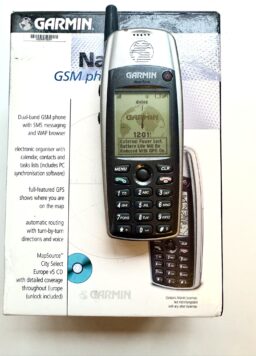
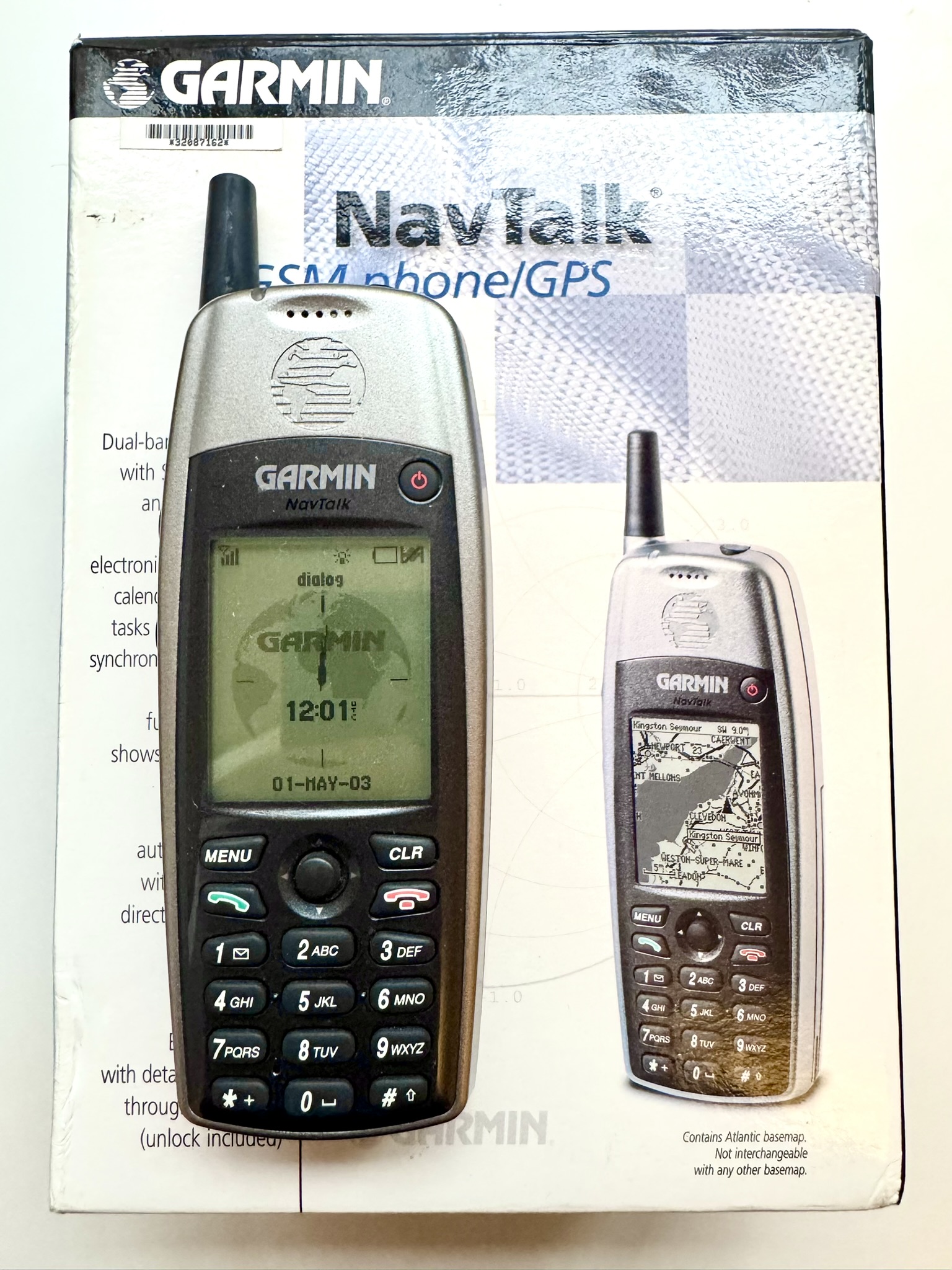
📰 Why this phone matters: The Garmin NavTalk GSM is one of the most unusual and forward-thinking mobile devices ever created, combining a full GSM phone with a complete Garmin GPS receiver years before smartphones existed. Released in the early 2000s in extremely small numbers, the NavTalk GSM offered true satellite navigation, waypoint management, coordinate tools, map display, and even GPS-enhanced SMS at a time when mobile phones were still primarily used for calls and messages.This unit is fully working, full box, and includes functional maps, making it exceptionally rare among surviving examples. The device was engineered in Olathe, Kansas and manufactured in Taiwan, using Garmin’s proprietary GPS engine integrated with a dual-band GSM system. Its large monochrome screen, robust keypad, external antenna, and rugged body reflect Garmin’s roots in professional navigation equipment far more than consumer mobile phones.
The NavTalk GSM stands as a landmark in mobile history: one of the earliest true GPS phones ever produced and the only GSM handset Garmin ever made. Decades later, it remains a fascinating and highly collectible hybrid, representing an ambitious moment when navigation technology and mobile communication first converged into a single device.
📝 Reviews when released: N/A 💔
-


Hitachi CRD 500
Quick View💎 Rarity Index: A (Rare)
👁 Evaluation in my collection: Good – 8.5/10
⏱ Life timer: 16h | 📦 Boxed: YES
📅 Release Year: 1995 | 💰 Release Price: N/A
📊 Units Sold: ~80k
📰 Why this phone matters: Similar to Nokia 2140 but branded as Hitachi📝 Reviews when released: N/A 💔
-


HP Ipaq – HW6915
Quick View💎 Rarity Index: C (Common)
👁 Evaluation in my collection: As New – 9.9/10
⏱ Life timer: N/A | 📦 Boxed: NO
📅 Release Year: 2006 | 💰 Release Price: N/A
📊 Units Sold: ~1.2M
📰 Why this phone matters: The iPAQ is a Pocket PC and personal digital assistant, first unveiled by Compaq in April 2000; the name was borrowed from Compaq’s earlier iPAQ Desktop Personal Computers. Since Hewlett-Packard’s acquisition of Compaq, the product has been marketed by HP. The devices use a Windows Mobile interface. In addition to this, there are several Linux distributions that will also operate on some of these devices. Earlier units were modular. “Sleeve” accessories, technically called jackets, which slide around the unit and add functionality such as a card reader, wireless networking, GPS, and even extra batteries were used. Later versions of iPAQs have most of these features integrated into the base device itself, some including GPRS mobile-telephony (sim-card slot and radio).📝 Reviews when released: N/A 💔
-


John’s 1 snow
Quick View💎 Rarity Index: S (Ultra Rare)
⭐ WOW Factor: The first world simplest mobile phone
👁 Evaluation in my collection: Good – 8.5/10
⏱ Life timer: N/A | 📦 Boxed: YES
📅 Release Year: 2010 | 💰 Release Price: ~80 €
📊 Units Sold: ~10k
📰 Why this phone matters: John’s Phone is a mobile phone that is made in the Netherlands and sold by John’s (Phone From The Supermarket BV). It claims to be the world’s most basic cell phone, allowing the user only to make and receive calls, with none of the features of modern smartphones such as a camera, Internet access and text messaging; the address book is a paper pad and a pen, built into the back of the device. It is built around the Keep It Simple concept.It was designed and developed by Hein Mevissen and Diederiekje Bok of Dutch advertising and design agency John Doe Amsterdam.It is marketed as being ideal for children, the elderly, and technophobes.📝 Reviews when released: Engadget 🔗
-
Jphone J-PE02 by Pioneer: Early Touch Era Legend
Quick View💎 Rarity Index: S (Ultra Rare)
⭐ WOW Factor: J-PE02 is one of the earliest touch interaction phones ever sold commercially
👁 Evaluation in my collection: New – 10/10
⏱ Life timer: 0 | 📦 Boxed: YES
📅 Release Year: 1999 | 💰 Release Price: N/A
📊 Units Sold: ~60k
📰 Why this phone matters: The Pioneer J-PE02 is one of the most unusual and forward-thinking handsets ever released on the Japanese market. Built by Pioneer Corporation and sold under the J-Phone Group in November 1999, this device represents a rare moment in phone history when non-telecom consumer electronics giants dabbled in mobile innovation. The result was a handset decades ahead of its time.Unlike the compact keypad phones of its era, the J-PE02 centered around a large front display designed for touch-style navigation, making it one of the very earliest commercially sold phones to experiment with stylus and screen-based input. This concept predates mainstream touch devices by years and shows how aggressively the Japanese market was pushing the boundaries of mobile interaction.
The design reflects Pioneers background in multimedia and in-car navigation: a clean silver housing, oversized screen, minimalist buttons, and an interface tailored for J-Sky internet services, early emoji support, and primitive web portals. Internally, the phone uses Pioneers PI-A4 platform, with full Japanese radio and telecom certifications confirming the unit as a late 1999 retail model.
This unit is fully working and BNIB, an exceptionally rare combination given Japans strict device recycling laws that eliminated most PDC-era phones from circulation. Having both pristine physical condition and functional electronics makes it an extraordinary survivor of a forgotten technological branch. It also stands as one of the few Pioneer-branded phones ever made, giving it a unique place in mobile history.
With its experimental touch-driven design, oversized screen, and deep ties to the pre-camera-phone era of J-Phone, the Pioneer J-PE02 remains a landmark collectible. It captures a pivotal moment before Sharp released the worlds first camera phone, reflecting the bold innovation race that defined Japans mobile golden age.
📝 Reviews when released: N/A 💔
-


Kyocera DS-320
Quick View💎 Rarity Index: A (Rare)
⭐ WOW Factor: The first ever phone that could have a camera attached to it, back in 1997
👁 Evaluation in my collection: Good – 8.5/10
⏱ Life timer: N/A | 📦 Boxed: YES
📅 Release Year: 1997 | 💰 Release Price: N/A
📊 Units Sold: ~100k
📰 Why this phone matters: The concept of mobile phones equipped with camera functions is not uncommon today. However, in the 90s of the last era, it is still a very incredible thing. At that time, the pager boom in China had just passed, and mobile phones were still in the ascendant. Fresh stuff, who would have thought of stuffing a small lens into such a small and exquisite body?
Japan’s Kyocera first thought of this. In 1997, Kyocera launched a brand-new Datascope series, including DS-110 and DS-320 mobile phones. Monochrome LCD screens seem unremarkable, but, Also launched with them is a very eye-catching accessory-VS-110.This accessory is driven by 2 AA batteries, can rotate 210 degrees, and can be movedIt can also be used as a standalone digital camera for video calls on the Internet. It is the world’s first mobile phone equipped with a camera and supports video calls.
Although the practicality is very low, it is the first step taken by mobile phone manufacturers. From 1997 to 1999, Kyocera conducted two years of research and development on the basis of this mobile phone. In May 1999 The VP-210 is officially launched, which integrates the camera on the top of the phone, is equipped with a 110,000-pixel front lens and a 2-inch TFT color screen. It can not only make video calls, but also take 20 photos and share them via email. The first camera phone in the true sense.📝 Reviews when released: W 01 🔗