

">

Showing 49–60 of 319 results
-


Motorla 3200 International
Quick View💎 Rarity Index: A (Rare)
⭐ WOW Factor: The first Motorola portable GSM
👁 Evaluation in my collection: BNIB – 10/10
⏱ Life timer: 0 | 📦 Boxed: YES
📅 Release Year: 1992 | 💰 Release Price: ~750 £
📊 Units Sold: ~2M
📰 Why this phone matters: The Motorola International 3200 was the first digital hand-held mobile telephone introduced in 1992, along with the more compact 5200, 5080, 7200 and 7500 “flip phones” introduced in 1994. It was preceded by the International 1000 and 2000 GSM phones, quite big (small portable suitcase), and although being the first GSM portable phones, they were not GSM certified, therefore couldn’t be officially connected to the network (first to be certified was Orbitel TPU 900).The International 3200 was designed to substitute the phones using the original analog cell technology developed in the late 1960s and early 1970s and first commercially available in 1983. Because of the 3200’s GSM technology, units still operates on any current 900 MHz GSM networks operating to this day (not with 3G SIM’s).
📝 Reviews when released: N/A 💔
-


Motorola 527 by Telecom
Quick View💎 Rarity Index: B (Uncommon)
👁 Evaluation in my collection: BNIB – 10/10
⏱ Life timer: 0m | 📦 Boxed: YES
📅 Release Year: 1993 | 💰 Release Price: N/A
📊 Units Sold: ~300k
📰 Why this phone matters: A series of GSM models was produced beginning in 1994, mostly in the UK, such as the International 5200, International 7500, and the International 8400, all running on the GSM 900 network. Many of these models are functionally identical but feature cosmetic differences or software upgrades.📝 Reviews when released: N/A 💔
-

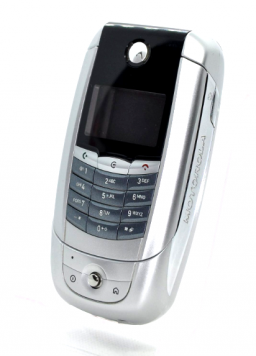
Motorola A780
Quick View💎 Rarity Index: A (Rare)
⭐ WOW Factor: The first Motorola with Linux Operating System
👁 Evaluation in my collection: Great – 9/10
⏱ Life timer: N/A | 📦 Boxed: NO
📅 Release Year: 2003 | 💰 Release Price: ~250 €
📊 Units Sold: ~500k
📰 Why this phone matters: The Motorola A780 is a cellular PDA running the Linux operating system.
It was introduced in 2003 and sold in eur;ope and Asia.Some models include GPS and navigation software. The phone is supplied with a number of applications including a POP and IMAP email client, Opera web browser, calendar and a viewer for PDF and Microsoft Office files. Calendar and address book can be synchronized with a Microsoft Exchange or SyncML server. The phone has a 1.3 megapixel camera recording still and video images. RealPlayer is included to play sound audio files and streamed audio and video. The phone has 48 megabytes of internal flash memory for storing user data and a slot for a microSD card. Both Bluetooth and USB are provided for communication with another computer. Character entry is via an on-screen QWERTY keyboard and hand writing recognition. Models including a GPS receiver are supplied with ALK Technologies’ CoPilot Live navigation software with street level maps of eur;ope.📝 Reviews when released: OS News 🔗
-
Motorola Aura R1 Diamond: The Motorola Crownpiece
Quick View💎 Rarity Index: S (Ultra Rare)
⭐ WOW Factor: A fully mechanical, diamond-framed phone with exposed gears and sapphire glass, the Motorola AURA Diamond is less a handset and more a wearable piece of moving luxury engineering.
👁 Evaluation in my collection: Great – 9/10
⏱ Life timer: N/A | 📦 Boxed: NO
📅 Release Year: 2009 | 💰 Release Price: ~5000$
📊 Units Sold: ~20k
📰 Why this phone matters: The Motorola AURA Diamond represents one of the most uncompromising luxury phones ever created, conceived at the intersection of mobile technology and mechanical watchmaking during the final years of the feature phone era. Evolving from the original AURA concept, the Diamond edition elevates the design through a bezel set with real diamonds, framing a circular sapphire crystal display and immediately setting the device apart from anything produced for the mass market. Beneath the sapphire, a fully exposed mechanical gear system is visible at all times, allowing the user to observe the precision components in motion whenever the phone is rotated open or closed, transforming a simple interaction into a deliberate mechanical experience.The chassis is crafted from stainless steel with a combination of polished and brushed finishes, while the rear panel features a finely textured metal surface that emphasizes durability and craftsmanship over decorative excess. A gold-accented central navigation wheel anchors the keypad and reinforces the watch-inspired design language, complemented by precisely machined screws and engraved internal components visible during disassembly. Unlike conventional sliding or clamshell phones, the AURA Diamond uses a smooth rotating opening mechanism engineered to withstand thousands of cycles, echoing the construction standards of high-end timepieces rather than consumer electronics.
Produced in extremely limited numbers and sold through select luxury channels, the AURA Diamond was never intended to compete on specifications or software features. Instead, it was designed as a statement object, prioritizing materials, mechanical precision, and exclusivity above all else. Its high launch price, limited availability, and unconventional engineering ensured that few were ever sold, and even fewer survive today in complete and original condition. As a result, the Motorola AURA Diamond stands as a rare artifact from a moment when mobile phones briefly crossed into the realm of mechanical art, making it a true collector-grade icon of luxury mobile design.
📝 Reviews when released: Cnet.Com 🔗
-


Motorola Aura R1: The Motorola Crownpiece
Quick View💎 Rarity Index: A (Rare)
⭐ WOW Factor: Saphire glass, stainless steel, swivel like opening mechanism, Swis Made gears for the mechanism.
👁 Evaluation in my collection: Great – 9.5/10
⏱ Life timer: N/A | 📦 Boxed: NO
📅 Release Year: 2008 | 💰 Release Price: ~2000$
📊 Units Sold: ~20k
📰 Why this phone matters: This unit is a Motorola Aura R1, one of the most mechanically advanced and visually distinctive luxury phones ever produced. Released in late 2008 as part of Motorola’s ultra-premium 4LTR line, the Aura was created not to compete with emerging smartphones, but to demonstrate the highest possible level of industrial craftsmanship, materials engineering, and mechanical design. The Aura is widely recognized as the final true mechanical masterpiece from Motorola before the touchscreen era ended the age of such devices.This particular unit is from the Australian market and is labeled simply as R1 rather than carrying the full Aura branding on the regulatory sticker. This detail is a documented regional distinction: Australian-market units were typically marked R1 only, while eur;opean units often carried the full “Aura” designation. For collectors, this is an important variant because it shows how Motorola adapted the labeling conventions for certain regions while retaining the exact same premium hardware. The unit is in as-new condition, showing minimal or no signs of use, making it highly desirable for collectors given the mechanical nature of the device and the low survival rate of pristine examples.
The Aura’s defining features remain extraordinary even today. Its iconic circular display offers 300 dpi resolution, protected by a 62-carat sapphire crystal lens cut and polished with extremely low-yield manufacturing processes. The sapphire window is among the most premium and expensive components ever mass-produced for a mobile device. The circular screen required Motorola to heavily modify its MotoMagx Linux platform, creating a custom UI layer and a unique rotational visual experience matched to the mechanical opening motion.
The rotating front mechanism is a mechanical achievement unmatched by any other production phone. Built with more than 200 precision-machined components, 130 micro ball bearings, and Swiss-made hardened steel gears, the hinge delivers a controlled, watch-like motion engineered to remain consistent over thousands of rotations. The metal surfaces use coatings derived from high-performance racing engines, and tolerances within the rotational assembly reach watchmaking precision levels. These characteristics place the Aura closer to horology than consumer electronics.
Constructed from surgical-grade stainless steel, the Aura R1 features hand-machined finishing, a weighty and solid feel, and a premium tactile character that cannot be replicated with modern materials. Despite its luxurious build, it retains practical functions: quad-band GSM, Bluetooth, a 2 MP camera, microSD support, custom audio themes, and a refined circular UI layout. At launch, the Aura sold for approximately 2000 $, reflecting both its engineering cost and its intended role as a luxury lifestyle object rather than a mass-market handset.
Because production was extremely limited and the device was released during the iPhone-driven smartphone revolution, few Aura units were manufactured, and even fewer survive in excellent mechanical condition. Many suffered rotational mechanism wear, sapphire damage, or cosmetic deterioration. As-new units, even without the original box, are very rare and increasingly valued as the Aura’s reputation continues to grow among collectors.
This unit represents one of the most iconic expressions of Motorola’s industrial design heritage. With its as-new presentation, Australian-market R1 label variant, circular sapphire display, watch-grade rotating mechanism, and stainless-steel construction, it stands as a top-tier collectible luxury phone. It captures a unique moment when mechanical artistry, materials science, and mobile technology converged to produce a device unlike anything before or since. The Aura R1 remains one of the most extraordinary and desirable non-smartphone luxury handsets ever made.
📝 Reviews when released: Cnet.Com 🔗
-


Motorola F3
Quick View💎 Rarity Index: C (Common)
⭐ WOW Factor: The first mobile phone to use electronic paper in its screen
👁 Evaluation in my collection: BNIB – 10/10
⏱ Life timer: 0m | 📦 Boxed: YES
📅 Release Year: 2006 | 💰 Release Price: ~20 €
📊 Units Sold: ~6M
📰 Why this phone matters: The F3 (frequently known as the Motofone) was a GSM phone available in two band variants, and was released on 28 November 2006.
The Motofone F3 was designed to appeal to the low-end market and developing countries, and was thus less functional, but also less expensive than most phones. Motorola made it appealing to developing markets and people with reading and visual difficulties by using only simple symbols and using speech synthesis to identify tasks in the menu.
The F3 was the first mobile phone to use electronic paper in its screen. Motorola used the term ClearVision to describe the new display, which was manufactured using E Ink’s electrophoretic imaging film. The electronic paper main display allowed for the phone’s thinness (no glass), longer battery life, and outdoor viewability (paper-like reflectivity). It had a backlight for the keypad and a slit that projects the backlight onto the screen so the display can be seen in darkness.The characteristics of the display were fairly restrictive. The text display contained only two lines of six characters each, making the use of text messaging (SMS) and data services less practical than on standard LCD displays. The display used a fixed ‘digital clock’ style font, with no functionality for changing between upper case and lower case text. All SMSs sent by the F3 were received entirely in lower case, and each character of any SMS received by the F3 is displayed in whichever case made the most sense using the font. Also, the non-alphabetic characters were severely limited due to this display, as the phone could only provide support for the following characters:
Comma (,) (periods . in incoming text messages are displayed as commas)
Hyphen (-)
Question mark (?)
At-sign (@)
Asterisk (*)
(+), to write this character, hold down the 0 key
No other non-alphanumeric characters could be entered, and on receiving an SMS any non-alphabetic character not listed above was displayed as a hyphen.Although the display could be restrictive when it came to text applications, the display was very energy efficient and conducive to extremely long battery life.
📝 Reviews when released: Trusted Reviews 🔗
-


Motorola Flipout
Quick View💎 Rarity Index: C (Common)
👁 Evaluation in my collection: Great – 9/10
⏱ Life timer: N/A | 📦 Boxed: NO
📅 Release Year: 2010 | 💰 Release Price: ~100 €
📊 Units Sold: ~700k
📰 Why this phone matters: Its square-shaped body has two parts that rotate near the bottom-right corner to reveal a five-row QWERTY keyboard below the screen. It has an accelerometer and includes a web browser with Adobe Flash Lite 3.0.The Flipout replaces the bigger Backflip.📝 Reviews when released: Mobile Review 🔗
-


Motorola Gleam
Quick View💎 Rarity Index: C (Common)
👁 Evaluation in my collection: Great – 9/10
⏱ Life timer: N/A | 📦 Boxed: YES
📅 Release Year: 2011 | 💰 Release Price: 99 €
📊 Units Sold: ~1M
📰 Why this phone matters: For the clamshell type factor and for the similar design, the terminal is considered the heir of the Motorola RAZR V3 .
On the upper part, under the lens of the 2 megapixel camera , there is a notification LED that informs about the time and about any incoming calls or messages; has Bluetooth 2.1 + EDR technology.
It is placed on the market in the three variants of gray ( gray ), thistle (thistle, a very light variety of violet ) and lacquer red ( lacquered red )📝 Reviews when released: N/A 💔
-
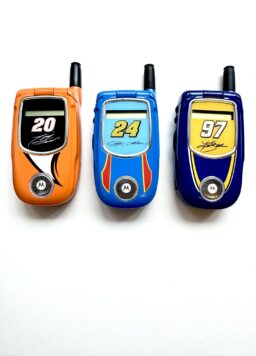
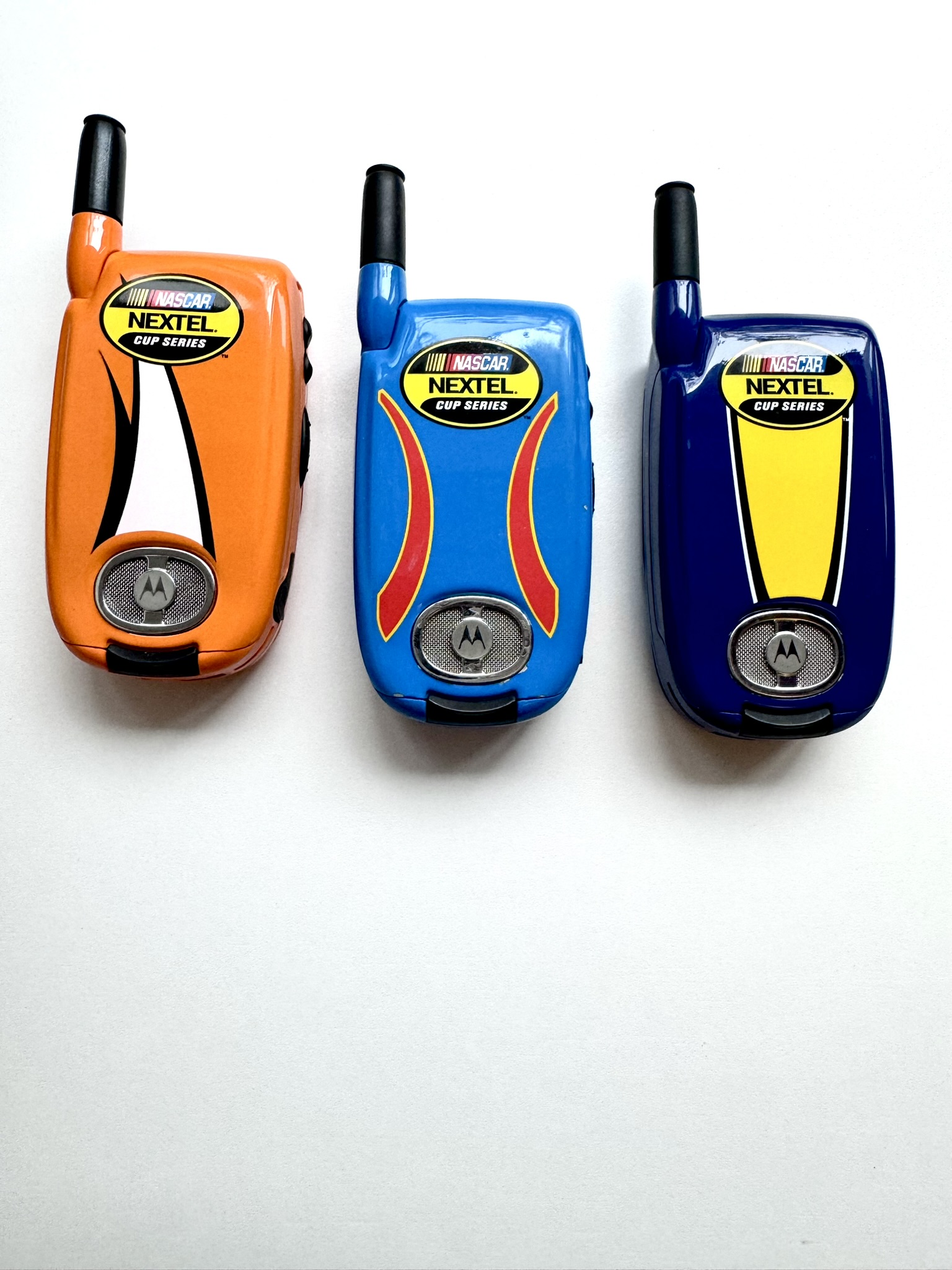
Motorola iDEN NASCAR: Dale Earnhardt Jr. – Driver Number 8
Quick View💎 Rarity Index: A (Rare)
⭐ WOW Factor: Limited-edition printed shells were released in very small quantities through promotions tied to NASCAR sponsors
👁 Evaluation in my collection: Great – 9/10
⏱ Life timer: N/A | 📦 Boxed: YES
📅 Release Year: 2003 | 💰 Release Price: N/A
📊 Units Sold: ~50k
📰 Why this phone matters: “This series brings together a rare and visually striking set of Motorola iDEN NASCAR edition phones, each one finished in the exact colors and markings of some of the most iconic drivers of the era. The front housings carry the bold driver numbers and printed signatures that fans once saw streaking around American tracks: the famous 8 used by Dale Earnhardt Jr.Other major NASCAR stars tied to number-based fan merchandising from the same period include Jimmie Johnson (48), Matt Kenseth (17), Kevin Harvick (29), Mark Martin (6), Rusty Wallace (2), Michael Waltrip (15), and others whose liveries became instantly recognizable in early 2000s motorsport culture. Mentioning them highlights the broader context in which these promotional Motorola phones were released.
Instead of simple decals, these editions feature full factory-printed graphics applied directly to the flip shell, giving them a premium, high-gloss look that stands far above ordinary Motorola releases. Built on Motorola’s rugged iDEN flip-phone platform, these devices were originally tied to the push-to-talk culture that defined the Nextel era. With their tall antennas, external displays, loud front speakers, and the classic M-logo medallions, they capture the unmistakable flavor of early 2000s telecom design.
Today, iDEN handsets with licensed NASCAR artwork are almost never found in mint or BNIB condition, making surviving units especially rare. Together, these themed phones stand as a vivid motorsport showcase, capturing the crossover between mobile technology and racing, and preserving a bold piece of American fan history that has long since disappeared from the mar
“
📝 Reviews when released: N/A 💔
-
Motorola iDEN NASCAR: Dale Jarrett – Driver Number 88
Quick View💎 Rarity Index: A (Rare)
⭐ WOW Factor: Limited-edition printed shells were released in very small quantities through promotions tied to NASCAR sponsors
👁 Evaluation in my collection: Great – 9/10
⏱ Life timer: N/A | 📦 Boxed: YES
📅 Release Year: 2003 | 💰 Release Price: N/A
📊 Units Sold: ~50k
📰 Why this phone matters: “This series brings together a rare and visually striking set of Motorola iDEN NASCAR edition phones, each one finished in the exact colors and markings of some of the most iconic drivers of the era. The front housings carry the bold driver numbers and printed signatures that fans once saw streaking around American tracks: 88 associated with Dale Jarrett and, in later seasons, Dale Earnhardt Jr. as well.Other major NASCAR stars tied to number-based fan merchandising from the same period include Jimmie Johnson (48), Matt Kenseth (17), Kevin Harvick (29), Mark Martin (6), Rusty Wallace (2), Michael Waltrip (15), and others whose liveries became instantly recognizable in early 2000s motorsport culture. Mentioning them highlights the broader context in which these promotional Motorola phones were released.
Instead of simple decals, these editions feature full factory-printed graphics applied directly to the flip shell, giving them a premium, high-gloss look that stands far above ordinary Motorola releases. Built on Motorola’s rugged iDEN flip-phone platform, these devices were originally tied to the push-to-talk culture that defined the Nextel era. With their tall antennas, external displays, loud front speakers, and the classic M-logo medallions, they capture the unmistakable flavor of early 2000s telecom design.
Today, iDEN handsets with licensed NASCAR artwork are almost never found in mint or BNIB condition, making surviving units especially rare. Together, these themed phones stand as a vivid motorsport showcase, capturing the crossover between mobile technology and racing, and preserving a bold piece of American fan history that has long since disappeared from the mar
“
📝 Reviews when released: N/A 💔
-
Motorola iDEN NASCAR: Driver Number Series
Quick View💎 Rarity Index: A (Rare)
⭐ WOW Factor: Limited-edition printed shells were released in very small quantities through promotions tied to NASCAR sponsors
👁 Evaluation in my collection: Great – 9/10
⏱ Life timer: N/A | 📦 Boxed: YES
📅 Release Year: 2003 | 💰 Release Price: N/A
📊 Units Sold: ~50k
📰 Why this phone matters: This series brings together a rare and visually striking set of Motorola iDEN NASCAR edition phones, each one finished in the exact colors and markings of some of the most iconic drivers of the era. The front housings carry the bold driver numbers and printed signatures that fans once saw streaking around American tracks: 24 in blue and yellow for Jeff Gordon, 20 in bright orange and black for Tony Stewart, 97 in deep blue with yellow for Kurt Busch, along with the famous 8 used by Dale Earnhardt Jr. and 88 associated with Dale Jarrett and, in later seasons, Dale Earnhardt Jr. as well.Other major NASCAR stars tied to number-based fan merchandising from the same period include Jimmie Johnson (48), Matt Kenseth (17), Kevin Harvick (29), Mark Martin (6), Rusty Wallace (2), Michael Waltrip (15), and others whose liveries became instantly recognizable in early 2000s motorsport culture. Mentioning them highlights the broader context in which these promotional Motorola phones were released.
Instead of simple decals, these editions feature full factory-printed graphics applied directly to the flip shell, giving them a premium, high-gloss look that stands far above ordinary Motorola releases. Built on Motorola’s rugged iDEN flip-phone platform, these devices were originally tied to the push-to-talk culture that defined the Nextel era. With their tall antennas, external displays, loud front speakers, and the classic M-logo medallions, they capture the unmistakable flavor of early 2000s telecom design.
Today, iDEN handsets with licensed NASCAR artwork are almost never found in mint or BNIB condition, making surviving units especially rare. Together, these themed phones stand as a vivid motorsport showcase, capturing the crossover between mobile technology and racing, and preserving a bold piece of American fan history that has long since disappeared from the mar
📝 Reviews when released: N/A 💔
-
Motorola iDEN NASCAR: Jeff Gordon – Driver Number 24
Quick View💎 Rarity Index: A (Rare)
⭐ WOW Factor: Limited-edition printed shells were released in very small quantities through promotions tied to NASCAR sponsors
👁 Evaluation in my collection: Great – 9/10
⏱ Life timer: N/A | 📦 Boxed: YES
📅 Release Year: 2003 | 💰 Release Price: N/A
📊 Units Sold: ~50k
📰 Why this phone matters: “This series brings together a rare and visually striking set of Motorola iDEN NASCAR edition phones, each one finished in the exact colors and markings of some of the most iconic drivers of the era. The front housings carry the bold driver numbers and printed signatures that fans once saw streaking around American tracks: 24 in blue and yellow for Jeff Gordon.Other major NASCAR stars tied to number-based fan merchandising from the same period include Jimmie Johnson (48), Matt Kenseth (17), Kevin Harvick (29), Mark Martin (6), Rusty Wallace (2), Michael Waltrip (15), and others whose liveries became instantly recognizable in early 2000s motorsport culture. Mentioning them highlights the broader context in which these promotional Motorola phones were released.
Instead of simple decals, these editions feature full factory-printed graphics applied directly to the flip shell, giving them a premium, high-gloss look that stands far above ordinary Motorola releases. Built on Motorola’s rugged iDEN flip-phone platform, these devices were originally tied to the push-to-talk culture that defined the Nextel era. With their tall antennas, external displays, loud front speakers, and the classic M-logo medallions, they capture the unmistakable flavor of early 2000s telecom design.
Today, iDEN handsets with licensed NASCAR artwork are almost never found in mint or BNIB condition, making surviving units especially rare. Together, these themed phones stand as a vivid motorsport showcase, capturing the crossover between mobile technology and racing, and preserving a bold piece of American fan history that has long since disappeared from the mar
“
📝 Reviews when released: N/A 💔